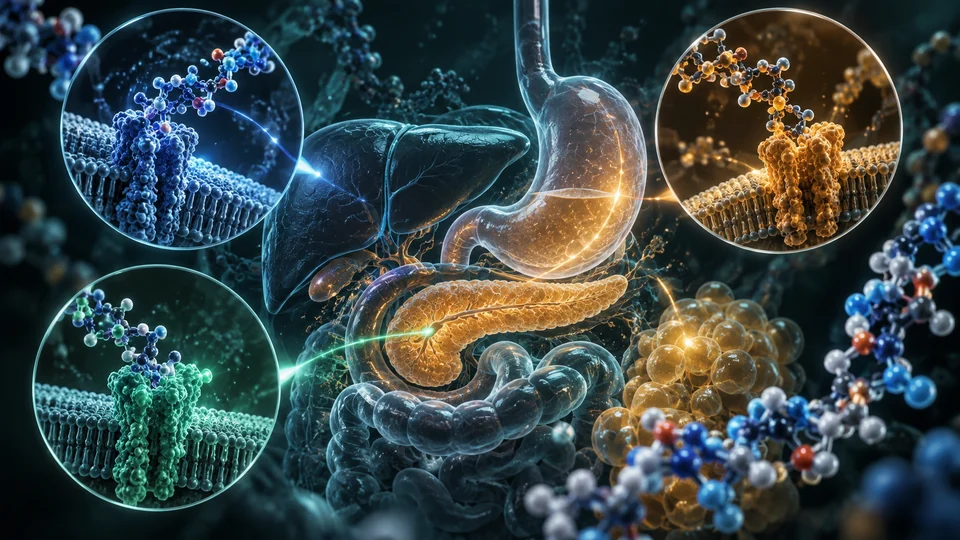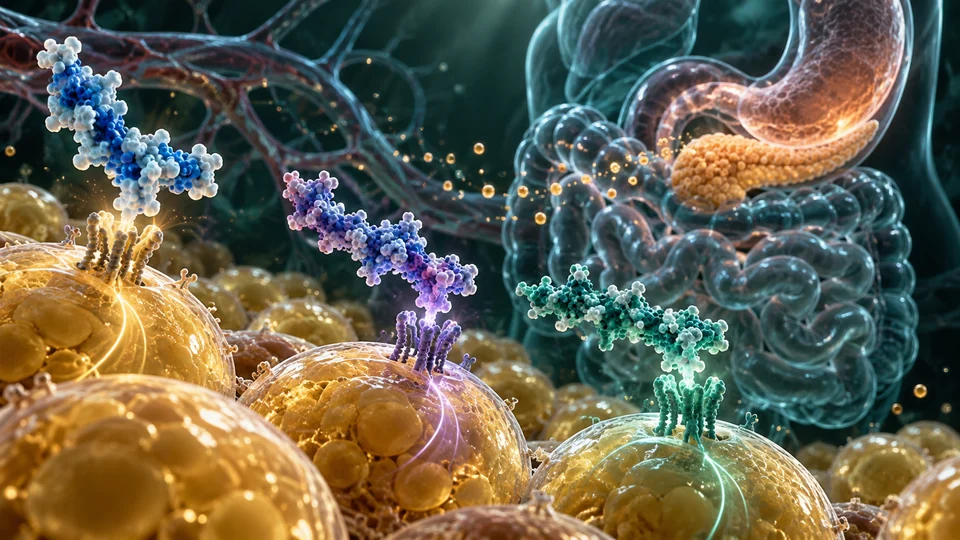
Semaglutide vs tirzepatide is one of the most searched comparisons in medicine, and retatrutide has now joined it. All three act on hormone systems involved in appetite and metabolism, but they do not target the same receptors, and they are not at the same stage of development. This is a scientific comparison, not a guide to choosing one. That is a decision for a prescriber who knows the person in front of them.
| Compound | Main receptor activity | Current position |
|---|---|---|
| Semaglutide | GLP-1 | Licensed medicine |
| Tirzepatide | GIP and GLP-1 | Licensed medicine |
| Retatrutide | GIP, GLP-1 and glucagon | Investigational |
In the UK, semaglutide and tirzepatide are authorised for particular weight management indications. Retatrutide is not approved anywhere. That difference matters more than any internet nickname.
Semaglutide: one main receptor
Semaglutide is a GLP-1 receptor agonist. GLP-1, glucagon like peptide 1, is a hormone the gut releases after eating. Among other things it boosts insulin release when glucose is high, damps down glucagon, slows the emptying of the stomach and reduces appetite. Semaglutide is built to activate the same receptor for about a week instead of a few minutes.
For weight management it is sold as Wegovy. In the STEP 1 trial, 1,961 adults with obesity or overweight lost a mean 14.9% of body weight over 68 weeks on the weekly injection, against 2.4% on placebo, alongside lifestyle support Human 1. Since then, the SELECT trial has shown fewer heart attacks, strokes and cardiovascular deaths in people with established heart disease 2, and benefit has been shown in kidney disease 3 and in a liver condition, MASH 4.
Tirzepatide: two receptors
Tirzepatide activates GIP receptors as well as GLP-1 receptors. GIP, glucose dependent insulinotropic polypeptide, is a second gut hormone released in response to food. So tirzepatide is not simply more GLP-1: it combines activity at two hormone receptors in one molecule, and what exactly the GIP arm adds is still debated.
In the UK it is sold as Mounjaro and is authorised for type 2 diabetes and for weight management in qualifying adults. In its main obesity trial, SURMOUNT-1, 2,539 adults without diabetes lost a mean 15.0% to 20.9% of body weight over 72 weeks depending on dose, against 3.1% on placebo Human 5.
Retatrutide: three receptors
Retatrutide activates GIP, GLP-1 and glucagon receptors, which is why it is called a triple agonist. You may see it called "GLP-3" online. There is no GLP-3 receptor; the name is shorthand for the three targets, and Lilly, which is developing the drug, describes it as scientifically inaccurate 6.
Adding glucagon sounds strange at first, because glucagon is usually taught as the hormone that raises blood glucose. That is true but incomplete: glucagon signalling also affects energy expenditure and how the body handles fat. The idea is to combine complementary signals in a single molecule rather than stack three appetite suppressants, with the incretin arms reducing how much energy comes in and the glucagon arm intended to increase how much goes out. Whether that makes a better medicine depends on safety, tolerability and long term outcomes, not weight loss alone. Retatrutide explained covers the drug in detail.
Side by side
| Compound | Mechanism | Half life | UK status | Evidence |
|---|---|---|---|---|
| Semaglutide | Semaglutide is an analogue of glucagon like peptide-1 (GLP-1), an incretin hormone released from intestinal L-cells after eating. | Approximately 165 hours (about 7 days) after subcutaneous administration, supporting once weekly dosing. | Licensed by the MHRA for type 2 diabetes and, at the 2.4 mg weekly dose, for weight management alongside diet and physical activity. | High-quality evidence |
| Tirzepatide | Tirzepatide is built on the backbone of glucose dependent insulinotropic polypeptide (GIP) rather than GLP-1, but it has been engineered to bind and activate both the GIP receptor and the GLP-1 receptor. | Approximately 5 days (roughly 117 hours) after subcutaneous administration, supporting once weekly dosing. | Licensed by the MHRA for type 2 diabetes and for weight management alongside a reduced calorie diet and increased physical activity. | High-quality evidence |
| Retatrutide | Retatrutide is a single synthetic peptide agonist at three class B G-protein coupled receptors: the GIP receptor, the GLP-1 receptor and the glucagon receptor. | Approximately 6 days after subcutaneous administration, as reported in phase 1 pharmacokinetic work, supporting once weekly dosing. | Not licensed by the MHRA. | Mixed evidence |
Semaglutide vs tirzepatide: there is a head to head trial
Online comparisons usually take numbers from unrelated trials and treat them as comparable. For semaglutide and tirzepatide there is something better. SURMOUNT-5, published in 2025, randomly assigned 751 adults with obesity but without type 2 diabetes to tirzepatide or semaglutide Human 7.
At 72 weeks, mean weight change was 20.2% with tirzepatide and 13.7% with semaglutide. Waist circumference also fell further with tirzepatide. Gastrointestinal side effects were the most common with both and were mostly mild to moderate. An earlier trial, SURPASS-2, found the same direction of result in people with type 2 diabetes 8.
For this population and this design, tirzepatide produced greater average weight loss. That is much stronger evidence than comparing separate trials.
Retatrutide vs tirzepatide, and retatrutide vs semaglutide
Here the certainty drops. No completed trial has compared retatrutide directly with either drug.
Retatrutide's own results are striking. In the phase 2 obesity trial, 338 adults lost between 8.7% and 24.2% of body weight at 48 weeks depending on dose, against 2.1% on placebo Human 9. In May 2026 Lilly announced the first phase 3 results: in TRIUMPH-1, people on the highest dose (12 mg) lost a mean 28.3% of body weight at 80 weeks, those on 9 mg 25.9% and those on 4 mg 19.0%, against 2.2% on placebo 10 11.
Those numbers are impressive, and they come from a company announcement rather than a published paper. More importantly, putting 28.3% from one trial next to 20.2% from another is not the same as randomising people to retatrutide or tirzepatide. The trials enrolled different people, ran for different lengths of time and handled people who stopped treatment differently, and any of that can move a headline figure by several points. BioRx keeps what the numbers suggest separate from what a trial has shown.
Which one has the strongest evidence?
It depends what you mean by strongest. Semaglutide has the longest clinical history and large outcome trials in heart, kidney and liver disease. Tirzepatide has large phase 3 programmes and direct evidence that it beats semaglutide for average weight loss. Retatrutide now has substantial phase 3 efficacy data, but the full reports are not yet published and no regulator has reviewed it.
That last point is not a technicality. Regulators weigh manufacturing, safety, efficacy and the overall balance of benefit and risk. The most impressive number in a press release is only one part of that.
Side effects
The three work in closely related ways, so their side effects overlap. With semaglutide and tirzepatide, nausea, diarrhoea, vomiting and constipation are common, usually dose related and worst while the dose is being increased. In January 2026 the MHRA strengthened its warnings on acute pancreatitis, including necrotising and fatal cases, for GLP-1 receptor agonists and dual GLP-1 and GIP receptor agonists 12. Both drugs are also contraindicated in people with a personal or family history of medullary thyroid carcinoma, because of thyroid tumours seen in rodents; whether that risk applies to humans is unresolved.
Retatrutide's side effects in TRIUMPH-1 were also mainly gastrointestinal. Lilly reported nausea in 28.6%, 38.4% and 42.4% of people on the 4 mg, 9 mg and 12 mg doses, against 14.8% on placebo, and 11.3% of the 12 mg group stopped treatment because of side effects, against 4.9% on placebo. Phase 2 also showed a dose dependent rise in heart rate whose long term meaning is unknown. This is one reason more weight loss cannot be the only measure of a medicine.
Development and UK status
- Semaglutide is licensed by the MHRA for type 2 diabetes and for weight management. As Wegovy it is licensed for weight management, while Ozempic and Rybelsus are licensed for type 2 diabetes. A semaglutide tablet for weight management was approved in June 2026. Prescription only.
- Tirzepatide is licensed by the MHRA for type 2 diabetes and weight management. Prescription only.
- Retatrutide is not licensed anywhere. In the UK it is available only inside clinical trials. Lilly has said it plans to file with the US FDA in the first quarter of 2027.
All three are also sold outside the regulated supply chain. Material bought online, including vials labelled for research use, has no verified identity, strength or sterility.
Semaglutide
High-quality evidenceMetabolic & incretin · 6 cited studies
Multiple large, replicated, placebo controlled randomised outcome trials with hard endpoints across diabetes, obesity, cardiovascular disease, kidney disease and liver disease, all independently verified against PubMed and ClinicalTrials.gov, supported by approved regulatory labelling in the US, UK and EU.
UK status. Licensed by the MHRA for type 2 diabetes and, at the 2.4 mg weekly dose, for weight management alongside diet and physical activity.
Tirzepatide
High-quality evidenceMetabolic & incretin · 6 cited studies
Multiple large randomised placebo controlled phase 3 trials with head to head active comparators, plus outcome trials in sleep apnoea and heart failure, with all four peer reviewed citations independently verified against PubMed and ClinicalTrials.gov, and approved regulatory labelling in the US, UK and EU.
UK status. Licensed by the MHRA for type 2 diabetes and for weight management alongside a reduced calorie diet and increased physical activity.
Retatrutide
Mixed evidenceMetabolic & incretin · 3 cited studies
Two consistent, well conducted phase 2 randomised placebo controlled trials are published and both were verified against PubMed, but no phase 3 report has been peer reviewed or published, no outcome data exist, and the compound is not approved by any regulator. Phase 3 topline announcements are sponsor communications and carry no independent tier weight.
UK status. Not licensed by the MHRA.
Which is best?
There is no single scientifically responsible answer, because the question hides three different ones. Which produced more weight loss when semaglutide and tirzepatide were compared directly? Tirzepatide. Which has produced the largest average weight loss figure in a phase 3 obesity trial? Retatrutide, so far. Which are approved medicines today? Semaglutide and tirzepatide. The mistake is turning those three questions into one.
Frequently asked questions
Is tirzepatide stronger than semaglutide?
In the SURMOUNT-5 head to head trial, tirzepatide produced more weight loss than semaglutide: a mean 20.2% against 13.7% at 72 weeks. That is a trial result, not a recommendation; which medicine suits a given person is a decision for a prescriber.
Is retatrutide better than tirzepatide?
Unknown. No trial has compared them directly. Retatrutide's larger figures come from separate trials, and its phase 3 results have not yet been published in full.
What is GLP-3?
An internet nickname for retatrutide, which acts on three receptors. There is no GLP-3 hormone or receptor, and Lilly calls the name scientifically inaccurate.
What is the difference between Ozempic, Wegovy and Mounjaro?
Ozempic and Wegovy are both semaglutide: Ozempic is licensed for type 2 diabetes and Wegovy for weight management. Mounjaro is tirzepatide.
Can I get retatrutide in the UK?
Only by taking part in a clinical trial. It is not licensed, and products sold online as retatrutide are not the trial medicine.
References
Studies marked "View study in BioRx" sit in the clinical studies index with their design and evidence grade.
- Wilding JPH et al. (2021). Once-Weekly Semaglutide in Adults with Overweight or Obesity. New England Journal of Medicine.PubMed · DOI · ClinicalTrials.gov · View study in BioRx
- Lincoff AM et al. (2023). Semaglutide and Cardiovascular Outcomes in Obesity without Diabetes. New England Journal of Medicine.PubMed · DOI · ClinicalTrials.gov · View study in BioRx
- Perkovic V et al. (2024). Effects of Semaglutide on Chronic Kidney Disease in Patients with Type 2 Diabetes. New England Journal of Medicine.PubMed · DOI · View study in BioRx
- Sanyal AJ et al. (2025). Phase 3 Trial of Semaglutide in Metabolic Dysfunction-Associated Steatohepatitis. New England Journal of Medicine.PubMed · DOI · View study in BioRx
- Jastreboff AM et al. (2022). Tirzepatide Once Weekly for the Treatment of Obesity. New England Journal of Medicine.PubMed · DOI · ClinicalTrials.gov · View study in BioRx
- Lilly, What to know about retatrutide
- Aronne LJ et al. Tirzepatide as Compared with Semaglutide for the Treatment of Obesity. N Engl J Med 2025;393(1):26-36
- Frías JP et al. (2021). Tirzepatide versus Semaglutide Once Weekly in Patients with Type 2 Diabetes. New England Journal of Medicine.PubMed · DOI · ClinicalTrials.gov · View study in BioRx
- Jastreboff AM et al. (2023). Triple-Hormone-Receptor Agonist Retatrutide for Obesity - A Phase 2 Trial. New England Journal of Medicine.PubMed · DOI · ClinicalTrials.gov · View study in BioRx
- Eli Lilly and Company (sponsor announcement) (2026). TRIUMPH-1 phase 3 trial of retatrutide in obesity (sponsor topline announcement). Company press release / investor communication. Identifiers not yet verifiedView study in BioRx
- Lilly, TRIUMPH-1 phase 3 topline results, 21 May 2026
- MHRA Drug Safety Update, strengthened warnings on acute pancreatitis, 29 January 2026