If you have read anything about weight loss, skincare, recovery or longevity lately, you will have come across the word peptide, usually as if it described one kind of treatment. It does not. So what are peptides? They are a huge family of molecules found throughout biology 1. Your body makes them. Some act as hormones, some carry messages between cells, and some influence appetite, blood sugar, inflammation or pigmentation. Scientists have also learned to make peptides in the laboratory and to modify them into medicines.
What is a peptide?
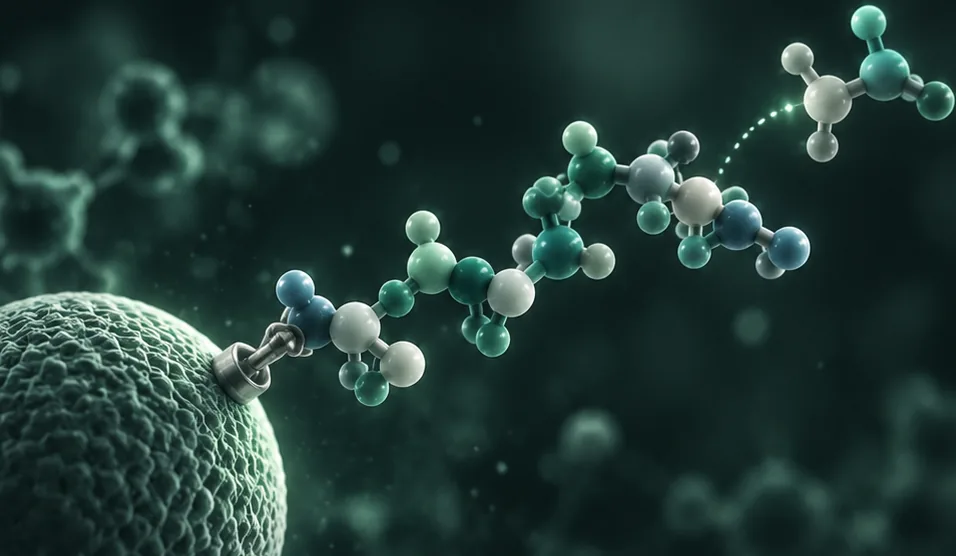
A peptide is a chain of amino acids joined together by chemical links called peptide bonds. Each bond forms between the carboxyl group of one amino acid and the amino group of the next, releasing a molecule of water.
Think of amino acids as letters and a peptide as a short word spelled with them. Change the order, drop a letter or add one, and you can end up with something that behaves very differently. That order, the sequence, is what gives each peptide its identity. It decides the chain's charge, whether parts of it coil into helices, which receptor it can fit and where enzymes will cut it.
Human biology builds its peptides and proteins from twenty standard amino acids. Laboratories are not limited to those twenty: they routinely use mirror image (D) amino acids and other unnatural building blocks, which is one of the main ways drug developers make peptides last longer. Sequences are written from the free amino end to the carboxyl end, in three letter codes (Gly-His-Lys) or one letter codes (GHK). The glossary explains the notation.
Peptides vs proteins
Peptides are generally described as relatively short chains of amino acids. Proteins are usually larger and often fold into far more complicated three dimensional structures 2. There is no universally agreed point where a peptide becomes a protein. The figure usually quoted is around 50 amino acids, and insulin, at 51, gets called both. Treat any exact cut off as a convenient definition rather than a law of nature.
Size matters in practice. Many short peptides do not hold a stable shape, and they tend to be cleared from the blood much faster than proteins. That difference drives a lot of what follows.
What do peptides do?
Asking what peptides do is a little like asking what medicines do. There is no single answer, because different peptides have completely different jobs 3.
Some act as hormones. Insulin is the best known example, keeping blood glucose in check, and glucagon is another peptide hormone working on the same system. GLP-1 is released from the gut after eating and contributes to appetite and glucose control. Modern medicines such as semaglutide were designed to mimic parts of GLP-1 signalling while staying active in the body for far longer.
Other peptides act in the nervous system, the immune system, blood vessels, digestion, pigmentation or communication between tissues. Peptides are not one biological system. They are one of the ways biology sends instructions.
How do peptides work?
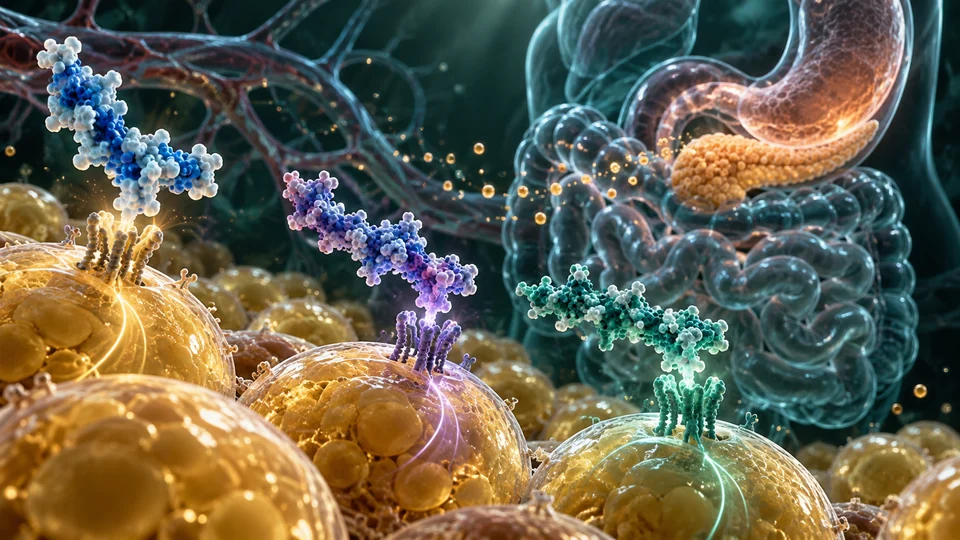
Most biologically active peptides work by binding to a target in the body, very often a receptor on the surface of a cell. Picture the cell as a building with different locks on the outside. A signalling molecule fits one lock and triggers a message inside.
Many peptide hormones work this way because they cannot easily cross the cell membrane. They bind to the receptor on the outside, and the receptor starts a chain of events within the cell. The result depends entirely on the receptor: one might change appetite, another insulin release, another the behaviour of a blood vessel or an immune cell.
A few distinctions matter more than any marketing claim. How tightly something binds is separate from how strong a response it produces. Some molecules switch a receptor on (agonists) while others occupy it and block it (antagonists). Related receptors look alike, and cross reactivity is the usual source of side effects. And a claim that a peptide binds receptor X describes a laboratory assay; it says nothing about whether the peptide reaches that receptor in a living body at a useful concentration. Part 04 of the foundations course goes further.
So saying that something is a peptide tells you surprisingly little. You need to know its sequence, its target and what evidence exists for its effects.
Where do peptides come from?
Some are made naturally. Your body constantly produces peptide hormones and other signalling peptides, often as larger precursor proteins that enzymes then cut down into the smaller active molecule, a little like a production line that builds a part, trims it to size and releases it when needed 4.
Others are synthetic. Laboratories can build a chosen amino acid sequence, either chemically, one amino acid at a time on a resin bead, or biologically, using engineered bacteria or yeast. They can also modify natural peptides so they last longer, bind more strongly or behave differently from the original. How peptides are actually made walks through the chemistry and where impurities come from.
Natural peptides and peptide medicines are not the same thing
Being natural does not make a molecule effective or safe, and being synthetic does not make it dangerous. What matters is the evidence.
A licensed peptide medicine will usually have been through years of laboratory research, animal testing, phased human trials, dose finding, manufacturing validation, stability testing, safety monitoring and regulatory review. A research peptide sold online may have been through almost none of that. Chemically, both are peptides. Scientifically, they can be worlds apart.
Examples of peptides
The range is the easiest way to see why the word on its own says so little.
- Insulin regulates blood glucose. Long acting analogues such as insulin glargine are licensed medicines.
- GLP-1 is a gut hormone involved in appetite and glucose control.
- Semaglutide is a modified GLP-1 receptor agonist used as a medicine.
- Tirzepatide activates both GIP and GLP-1 receptors and is licensed for type 2 diabetes and weight management.
- Retatrutide is an investigational drug that activates GIP, GLP-1 and glucagon receptors.
- Oxytocin is a nine amino acid hormone, used in hospitals to induce labour and to prevent and treat bleeding after birth.
- Octreotide, teriparatide and leuprorelin are long established peptide medicines in hormone disorders, osteoporosis and cancer care.
- GHK-Cu is a naturally occurring copper binding peptide studied mainly in skin and wound biology.
- CJC-1295 is a synthetic analogue that acts on the growth hormone releasing hormone pathway.
- BPC-157 is an experimental synthetic peptide with a large animal literature and very little reliable human evidence.
That last comparison matters. Semaglutide and BPC-157 are both peptides, but the human evidence behind them is radically different.
Major peptide mechanism classes
The peptide directory groups every compound by what it does. Each class below opens its filtered view:
- Metabolic & incretin 27
- GH secretagogues 8
- Growth factors 7
- Tissue repair 8
- Immune modulation 7
- Antimicrobial & antibiotic 5
- Neuroactive 24
- Melanocortin 9
- Reproductive & GnRH 11
- Endocrine & pituitary 17
- Cardiovascular & haemostasis 10
- Gastrointestinal 12
- Oncology & diagnostic 11
- Longevity & mitochondrial 21
- Cosmetic & dermatological 19
Why medicine is interested in peptides, and why they are hard to use
One attraction is specificity. A peptide can sometimes be designed to act very selectively on one receptor, which offers a way to change one signalling pathway without touching every system in the body.
The difficulty is that the body is very good at breaking peptides down. Digestive enzymes treat a swallowed peptide much like dietary protein, which is why most traditional peptide medicines are injected. In the blood, enzymes clip peptides within minutes: native GLP-1 has a half life of about two minutes. Small peptides are also filtered out quickly by the kidneys.
Drug developers have four main fixes. They join the ends of the chain into a ring, swap in mirror image amino acids where enzymes cut, attach a polyethylene glycol chain to make the molecule too big for the kidneys to filter, or attach a fatty acid so the peptide rides on albumin, a protein in the blood. Semaglutide uses the last of these and lasts about a week, long enough for a single weekly injection. Peptide drug design is often less about discovering a magic new molecule and more about taking biology that already exists and making it usable.
Are all peptide medicines injections?
No, although most are, for the reasons above. In June 2026 the MHRA approved a semaglutide tablet for weight management, the first GLP-1 tablet licensed for weight loss in the UK 5. Oral semaglutide only works because it is combined with an absorption enhancer and taken under strict fasting conditions, and even then very little of each dose is absorbed.
Researchers are also exploring nasal, skin and other routes. The fact that a peptide can in theory be absorbed by a given route does not show that every product using that route works. The formulation needs its own evidence.
What are research peptides?
Scientifically, a research peptide is simply a peptide being studied. Commercially, the phrase has become a label for unapproved compounds sold online, often marked "for research use only" or "not for human consumption".
That label does not mean a product has been shown to be safe for people. It usually means the opposite: it has not been authorised as a medicine for human use, and it carries no requirement for pharmaceutical manufacturing, sterility or verified identity. The distinction matters most for compounds such as BPC-157, TB-500, MOTS-c and the peptide stacks discussed on social media. Part 07 of the course explains the legal categories.
Do peptides actually work?
Some unquestionably do. Insulin changed medicine. GLP-1 based medicines have been studied in thousands of people. Peptides are used in fertility treatment, endocrinology, cancer care and many other areas.
Those successes are no evidence that all peptides work. Every compound has to stand on its own evidence, and that is where the online peptide world goes wrong most often. A mechanism is described, it sounds sensible, the molecule does something interesting in mice, and somewhere between the study and social media "this deserves further research" becomes "this heals humans". A plausible mechanism is not proof, an animal study is not a clinical trial, and a dozen anecdotes on Reddit are not a controlled experiment.
BioRx grades every compound on a four tier scale: high quality evidence, mixed, limited, and preclinical only. The grade describes how well a compound has been studied, not whether it works. The evidence method sets out the criteria, and six questions do most of the work: what species, how many people for how long, whether the study was randomised and blinded, whether the main outcome was registered in advance, who paid for it, and whether anyone independent has repeated it.
Why animal research does not automatically translate to humans
Animal research is essential. It helps researchers understand mechanisms and decide what is worth studying further. But animals are not small humans. A compound can work beautifully in a mouse and fail in people, because doses, metabolism and disease models all differ, and side effects can appear that never showed in animals.
Two peptides at opposite ends of the scale make the point. For BPC-157, a 2025 systematic review screened 544 papers and included 36; 35 were Animal or laboratory studies and one was a small retrospective clinical series 6. For semaglutide, the STEP 1 trial randomised 1,961 adults with obesity and found mean weight loss of 14.9% on the drug against 2.4% on placebo over 68 weeks Human 7, and large outcome trials followed.
This is why BioRx keeps preclinical evidence separate from human clinical evidence. That is not being negative about an interesting compound. It is describing what is actually known.
Are peptides steroids?
No. Peptides and anabolic steroids are chemically and biologically different. Steroid hormones are made from cholesterol; peptides are made from amino acids. Both can change signalling in the body, but usually in different ways: steroid hormones can pass through the cell membrane and act on receptors inside the cell, while many peptide hormones work through receptors on the cell surface.
Are peptides safe?
There is no meaningful answer for peptides as a group. Some peptide medicines have extensive safety data and others have almost none. Safety depends on the molecule, the dose, the formulation, how it is given, its purity, how long it is used, other medicines being taken and the health of the person taking it. Peptide should never be read as a synonym for safe.
Peptide regulation in the UK
In the UK, a peptide sold or promoted for a medical purpose is a medicinal product under the Human Medicines Regulations 2012 and needs a marketing authorisation from the MHRA. Broadly, a peptide sits in one of four positions: a licensed medicine, trialled and made to pharmaceutical standards; a specially prepared product made for an individual patient; a research reagent sold as not for human use; or a cosmetic ingredient limited to cosmetic claims. Many peptides are also banned in sport under the WADA Prohibited List whatever their legal status. Every record in the directory states the UK, US and WADA position for that compound.
Frequently asked questions
What is a peptide in simple terms?
A short chain of amino acids, the same building blocks as proteins, joined by peptide bonds. Many act as signals in the body.
What is the difference between a peptide and a protein?
Length and, usually, structure. Proteins are longer and fold into stable shapes. The boundary, often put at around 50 amino acids, is a convention.
Are peptides legal in the UK?
It depends on the peptide and how it is sold. Licensed peptide medicines are legal on prescription. Outside clinical trials and a few narrow exemptions, supplying an unlicensed peptide for human use is unlawful under the Human Medicines Regulations 2012, whatever the label says.
Are research peptides safe?
For most there is no adequate human safety data at all, and products sold for research use carry no guarantee of identity, purity or sterility. Each compound's record states what is known.
Why are most peptide medicines injected?
Because digestive enzymes break peptides down before they can be absorbed. Oral forms such as the semaglutide tablet exist, but they need special formulation and absorb poorly.
Explore the BioRx peptide directory
Every compound mentioned here has a structured record in the peptide directory: mechanism, the studies that exist, an explicit evidence grade, safety and regulatory status. The clinical studies index lists every study we cite, with links to the primary source.
References
Studies marked "View study in BioRx" sit in the clinical studies index with their design and evidence grade.
- National Library of Medicine, MeSH: Peptides
- Kaprive JF, Merheb E. Protein Structure and Function. StatPearls, NCBI Bookshelf
- Martini S, Tagliazucchi D. Bioactive Peptides in Human Health and Disease. Int J Mol Sci 2023;24(6):5837
- Coassolo L, Wiggenhorn A, Svensson KJ. Understanding peptide hormones: from precursor proteins to bioactive molecules. Trends Biochem Sci 2025;50(6):481-494
- MHRA, First GLP-1 tablet for weight loss approved in the UK, 11 June 2026
- Vasireddi N et al. (2025). Emerging Use of BPC-157 in Orthopaedic Sports Medicine: A Systematic Review. HSS Journal.PubMed · DOI · View study in BioRx
- Wilding JPH et al. (2021). Once-Weekly Semaglutide in Adults with Overweight or Obesity. New England Journal of Medicine.PubMed · DOI · ClinicalTrials.gov · View study in BioRx