
Peptide science
from first principles
No prior biochemistry assumed. Each part builds on the last, and every section states plainly where established science ends and speculation begins.
01 · Structure
Bonds, sequence, folding, and the peptide-protein boundary.
02 · Synthesis
Solid-phase chemistry, recombinant expression, and impurities.
03 · Pharmacokinetics
Why peptides vanish, and the four ways to make them last.
04 · Receptors
Binding, agonism, selectivity, and downstream signalling.
05 · Evidence
Reading a study without being taken in by the abstract.
06 · Quality
Purity, identity, sterility, and what a CoA leaves out.
07 · Regulation
Approved medicine, research chemical, cosmetic, or nothing at all.
Then: the library
Apply all seven lenses to individual compounds.
What a peptide actually is
Amino acids link through a peptide bond : an amide formed between one residue's carboxyl group and the next one's amino group, releasing water. Repeat that and you get a chain with a repeating backbone and a set of variable side chains hanging off it.
The line between "peptide" and "protein" is a convention, not a law of nature. Under roughly 50 residues we say peptide; above it, protein. Insulin sits awkwardly across the boundary at 51 residues and gets called both.
Four things the sequence determines
- Charge and solubility : how many acidic and basic side chains it carries, and therefore how it behaves in water and in formulation.
- Secondary structure : whether stretches form helices, sheets or stay disordered.
- Target recognition : which receptor pocket it can physically occupy, and how tightly.
- Degradation sites : where proteases will cut, which sets the half-life before any engineering.
Because all four follow from the sequence, a single substitution can change everything downstream. Two peptides differing by one residue are not variants of the same thing in any useful sense.
Notation you will meet
| Form | Example | Meaning |
|---|---|---|
| Three-letter | His-Ala-Glu-Gly | Readable; used in figures |
| One-letter | HAEG | Compact; used in databases |
| Fragment | GLP-1 (7-37) | Residues 7 to 37 of the parent |
| D-isomer | D-Ala | Mirror-image residue |
| Modified | Ac-…-NH₂ | Capped ends, slower degradation |
Sequences are always written N to C
Left end is the free amino group, right end the carboxyl. Synthesis, confusingly, runs the other way. Chains are built C to N.
Two ways to build one
Chemistry or biology. The choice drives cost, length limits, and the impurity profile you inherit.
Solid-phase peptide synthesis
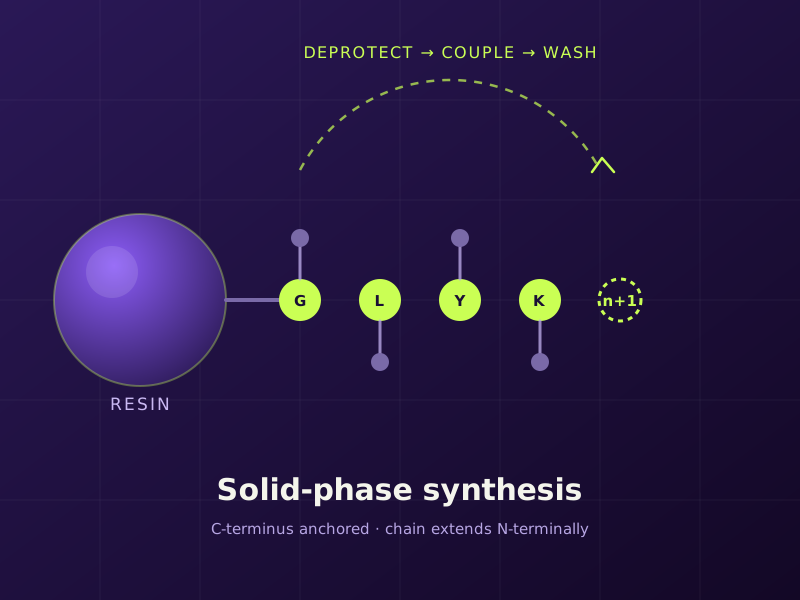
Merrifield's 1963 insight was to anchor the growing chain to an insoluble resin bead. Excess reagents can then be washed away at every step instead of purified out, which is what makes automation possible.
Each cycle deprotects the chain's N-terminus, couples the next protected amino acid, and washes. Repeat once per residue, then cleave from the resin.
- Any residue you like
Including D-amino acids and non-natural building blocks biology cannot make.
- Yield compounds
99% per step over 30 steps still leaves you around 74%. Long chains get expensive fast.
Recombinant production
Insert the coding sequence into bacteria or yeast, let the organism's own ribosomes assemble the chain, then extract and purify. This is how insulin has been made since the early 1980s.
Economical at scale and unbounded in length, but restricted to the twenty proteinogenic amino acids unless you go to considerable extra effort.
- Scales cheaply
Cost per gram falls sharply with batch size, unlike stepwise chemistry.
- Host-derived impurities
Residual host-cell protein and endotoxin become the critical quality attributes.
Why peptides disappear
Three clearance routes stand between a peptide and a useful duration of action.
Digestive proteolysis
Pepsin, trypsin and chymotrypsin treat an oral peptide as food. Very little survives the stomach and small intestine intact, which is why almost none are taken by mouth.
Circulating peptidases
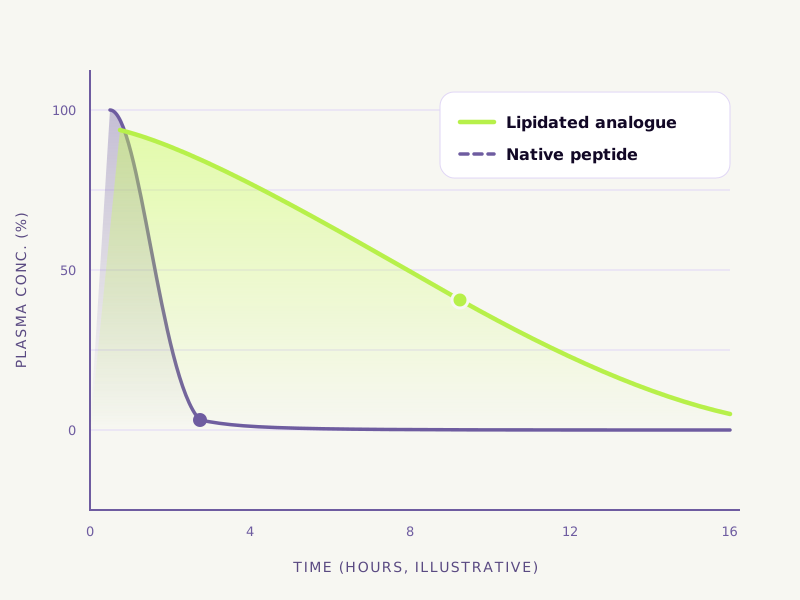
Enzymes such as DPP-4 clip specific residues from circulating peptides within minutes. Native GLP-1's half-life is on the order of two minutes for exactly this reason.
Renal filtration
Below roughly 5 kDa, molecules pass the glomerulus freely. Small peptides are filtered out of blood almost as fast as they arrive.
The four fixes
Every long-acting peptide medicine on the market uses at least one of these, and usually two.
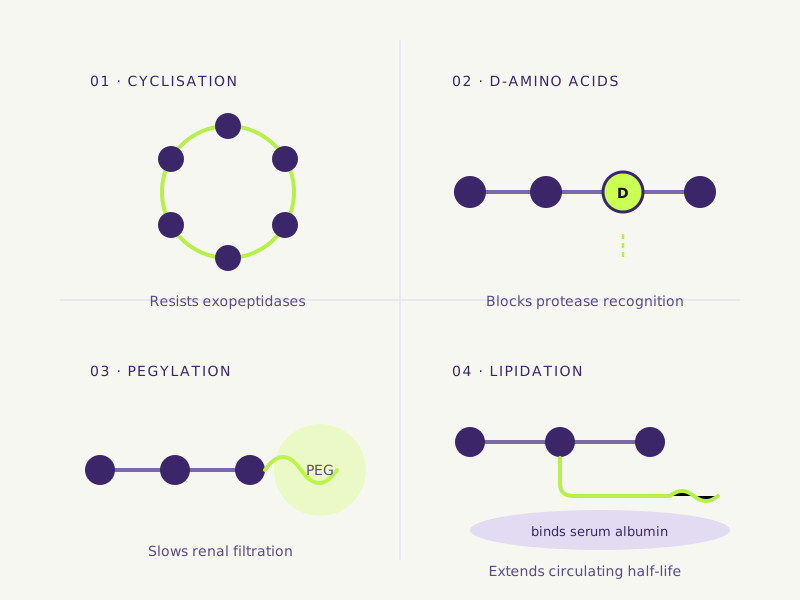
- Cyclisation
Joining the ends removes the free termini that exopeptidases need to start chewing.
- D-amino acid substitution
Proteases evolved to recognise L-isomers. A mirror-image residue at the cleavage site stalls them.
- PEGylation
A polyethylene glycol chain raises the effective size above the renal filtration threshold.
- Lipidation
A fatty-acid tail binds serum albumin, borrowing its long residence time. This is how weekly dosing became possible.
Binding is not the same as working
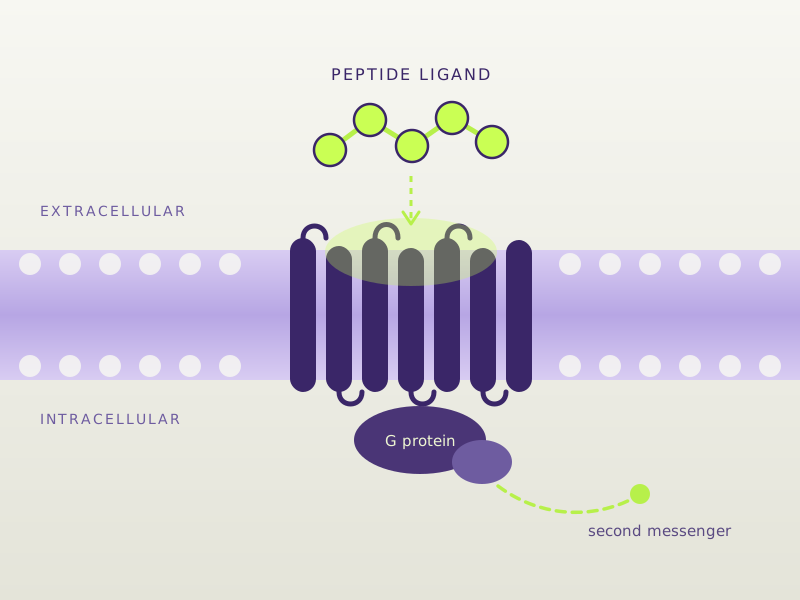
Most therapeutic peptides act on G-protein coupled receptors. The peptide occupies an extracellular pocket, the receptor changes shape, and an intracellular cascade fires. Four distinctions matter more than any marketing claim.
- Affinity vs efficacy
How tightly it binds is separate from how much response that binding produces. A tight binder can do nothing at all.
- Agonist vs antagonist
One activates the receptor; the other occupies it and blocks the natural ligand. Same pocket, opposite outcome.
- Selectivity
Related receptors share pocket architecture. Cross-reactivity is the usual source of off-target effects.
- Receptor downregulation
Sustained stimulation makes cells reduce receptor density. Effects can fade even at a constant concentration.
"Binds to receptor X" proves very little
It is a statement about a binding assay, usually in isolated cells. It says nothing about whether the peptide reaches that receptor in a living body, at what concentration, or with what clinical consequence.
Reading a study properly
Six questions that separate a finding worth acting on from one worth noting.
What species, and in what preparation?
Cell culture, rodent, or human? An effect in isolated cells at concentrations unreachable in a living body is a mechanistic hint, not a clinical result.
How many participants, and for how long?
Twelve people for four weeks cannot establish safety or durable benefit, however clean the result looks.
Was it randomised, controlled and blinded?
Without a control arm you cannot separate the intervention from regression to the mean, natural recovery, or expectation.
What was the primary endpoint, and was it pre-registered?
Endpoints chosen after seeing the data will find something. Compare the published outcome against the registry entry.
Who funded it, and who wrote it?
Industry funding does not invalidate a study, but it belongs in your weighting alongside everything else.
Has anyone independently replicated it?
A single striking result is a hypothesis. Replication by an unrelated group is what turns it into knowledge.
What a certificate of analysis covers
And, more usefully, what it does not.
| Test | Answers | Does not answer |
|---|---|---|
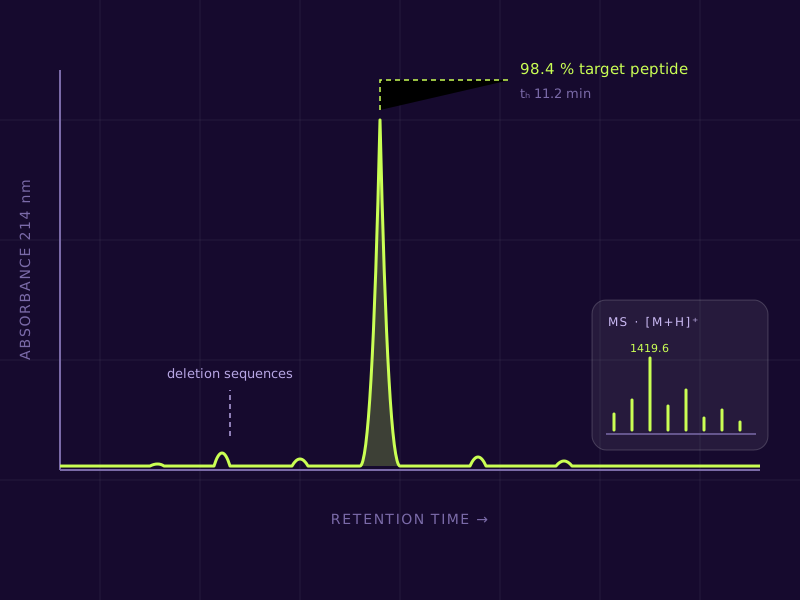
| HPLC purity | What fraction of UV-absorbing material is the main peak | Whether the main peak is the right molecule; anything that does not absorb at 214 nm |
| Mass spectrometry | Whether the molecular mass matches the intended sequence | Whether stereochemistry is correct: D and L isomers weigh the same |
| Amino acid analysis | Overall composition | The order of residues |
| Endotoxin (LAL) | Bacterial pyrogen load | Viable organisms, fungal contamination |
| Sterility | Absence of viable organisms at time of test | Anything about the container after it is opened |
| Water & counter-ion | Net peptide content by weight | Frequently omitted entirely: a vial labelled 5 mg may hold appreciably less peptide |
A certificate is only as trustworthy as its issuer
Documents supplied by a seller, without an independent laboratory's name, accreditation number and a batch identifier that matches the vial in hand, carry little evidential weight. Analytical certificates are also straightforward to fabricate.
Four legal categories, one molecule
The same peptide can sit in different categories in different countries. Status, not chemistry, governs most practical questions.
Licensed by a regulator
Has completed controlled trials, carries an approved label with indications and warnings, and is manufactured under GMP with batch traceability. Prescription-only in most jurisdictions.
Prepared by a pharmacy
Made for an individual patient, typically where an approved product is unavailable. Oversight varies enormously by country and by pharmacy; it is not equivalent to an approved product.
Laboratory reagent
Sold explicitly not for human use. No pharmaceutical-grade manufacturing requirement, no sterility guarantee, no clinical oversight. The "not for human consumption" label is a legal position, not a formality.
Topical ingredient
Regulated for surface safety rather than systemic efficacy. Claims must stay within cosmetic bounds (appearance, not physiology), which is why the language on the packaging is so carefully hedged.
One more category worth knowing
Many peptides appear on the World Anti-Doping Agency prohibited list, including growth hormone secretagogues and their releasing factors. Competing athletes face sanctions regardless of a substance's legal status where they live.
That is the foundation.
Now apply it.
The library takes each of these seven lenses and runs individual compounds through them, so you can see exactly where a given peptide is strong and where it is unsupported.