How peptides are actually made
Merrifield's resin trick, why yield compounds so brutally with length, and where the impurities in any given vial come from.
The tier on every library entry is not an opinion about whether a peptide is interesting. It is a statement about what has actually been demonstrated, in humans, by someone with no stake in the answer.
Multiple randomised controlled trials with consistent direction of effect, or approval by a major regulator on the basis of such trials. Adverse effects are characterised well enough to appear on a label.
Not a claim of safety for everyone : colistin sits here and is meaningfully nephrotoxic. It is a claim that the effects, good and bad, are known.
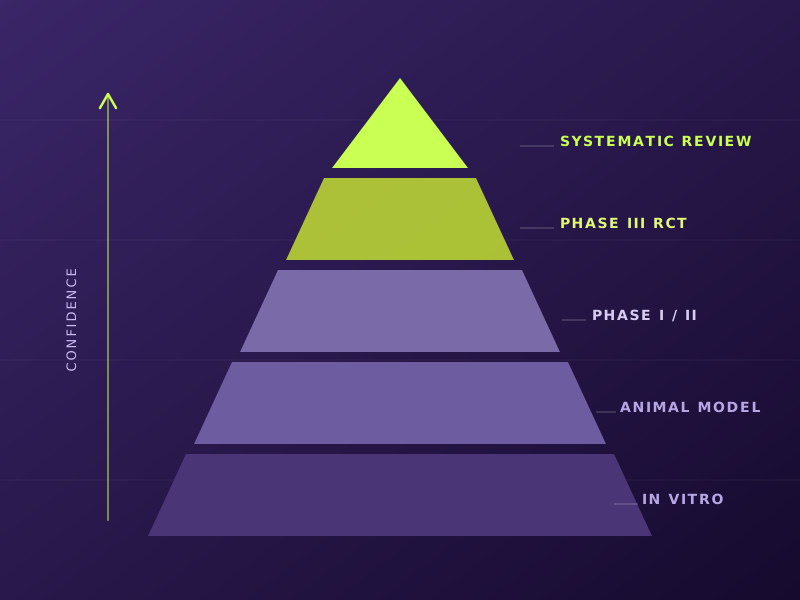
Trials have been run in people, but they are small, short, conflicting, confined to one region's literature, or measure surrogate endpoints rather than outcomes that matter.
This is the most commonly misread tier. "Mixed" means the question is genuinely open, not that it leans positive.
One or two human studies, typically unblinded, uncontrolled, very small, or authored by parties with a direct commercial interest. Also used where development was abandoned after early-phase work.
A discontinued programme is informative. Compounds are usually dropped because they did not work, not because nobody noticed them.
Cell culture and animal work only. The mechanism may be well described and the animal results striking; neither tells you what happens in a person, at an achievable exposure, over a meaningful period.
Most peptides discussed enthusiastically online sit here. That is the single most useful thing this site can tell you.
Search trial registries before the literature. Registered studies that never published are themselves a finding.
Compare the pre-registered primary endpoint with the one reported. Divergence is downgraded.
A null result from a good trial outranks a dramatic result from a poor one.
Work concentrated in a single group or institution is capped below Strong, however voluminous.
Tiers carry a review date. They move down as often as up.
These account for most of the distance between what a study showed and what gets repeated about it.
A result in rats is restated without the species. "Accelerates tendon healing" is true of the rodent study and unestablished in people, but only one version travels.
Concentrations that work in a dish are frequently unreachable in living tissue. An in-vitro effect at 100 µM says little if plasma levels peak three orders of magnitude lower.
A marker moves, so the outcome is assumed to follow. Raising IGF-1 is not the same as improving body composition, strength, or anything a person would notice.
A review cites a review that cites a preprint. Follow the chain to the primary source and the confident claim frequently dissolves into a hedge.
Negative results go unpublished. A compound with five positive small studies may also have had eleven that never appeared.
A plausible pathway is treated as evidence of effect. Most drug candidates with excellent mechanistic stories still fail in phase II.
| Entry | Tier | Deciding factor |
|---|---|---|
| Tirzepatide | High-quality | Multiple large randomised phase III trials with pre-registered endpoints, independent replication, and regulatory approval across several jurisdictions. |
| Thymosin α1 | Mixed | Genuine human trials across several indications, but results vary in direction and quality, and approval is regional rather than universal. |
| CJC-1295 | Limited | Early-phase human pharmacokinetic data exist, but development was discontinued and no efficacy outcome was ever established. |
| BPC-157 | Preclinical | Extensive rodent literature concentrated in a small number of affiliated groups; no published randomised controlled trial in humans. |
Merrifield's resin trick, why yield compounds so brutally with length, and where the impurities in any given vial come from.
Digestive proteases, circulating peptidases and renal filtration, and the four engineering routes around all three.
Purity, identity, sterility and net peptide content are four different questions. Most certificates answer one.
A tour of the gap between a striking animal result and a demonstrated human benefit, using three real examples.
A peptide can bind a receptor beautifully and do nothing at all. The distinction explains several disappointing trials.
Approved medicine, compounded preparation, research reagent, cosmetic ingredient, and why the label decides more than the chemistry.