Why you can't just swallow a peptide
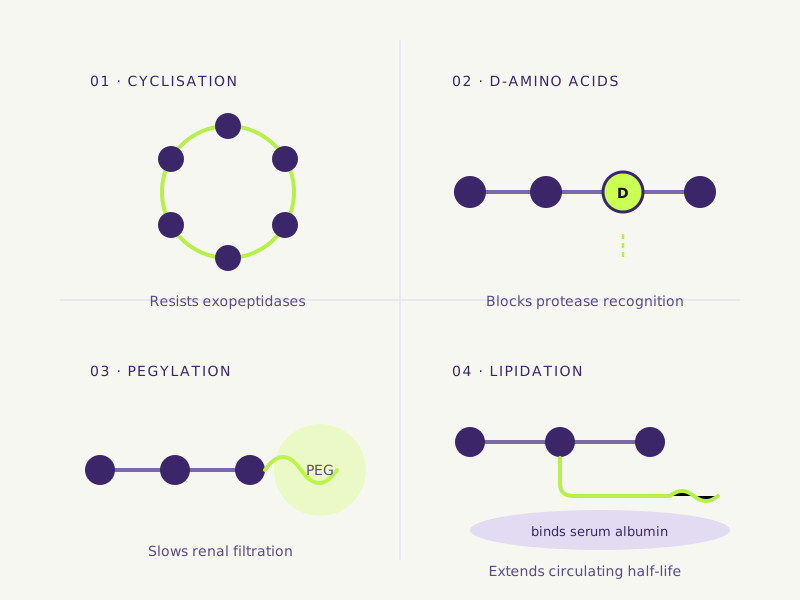
What happens between the injection site and the receptor, and the four ways developers extend the journey.

Bruce Merrifield's insight was almost embarrassingly simple: tie the molecule down so you can wash everything else away. It won a Nobel Prize, and it is still the reason a 30-residue peptide costs what it does.
Making a peptide is conceptually trivial: join amino acids in order. Doing it in solution is not. Every coupling step produces a mixture (your product, unreacted starting material, and side products), and each one has to be isolated before the next step can begin. Purification means precipitation, crystallisation or column chromatography, and every round loses material.
For a five-residue peptide this is tedious. For a thirty-residue peptide it is a research project measured in months, with a yield that rounds to nothing.
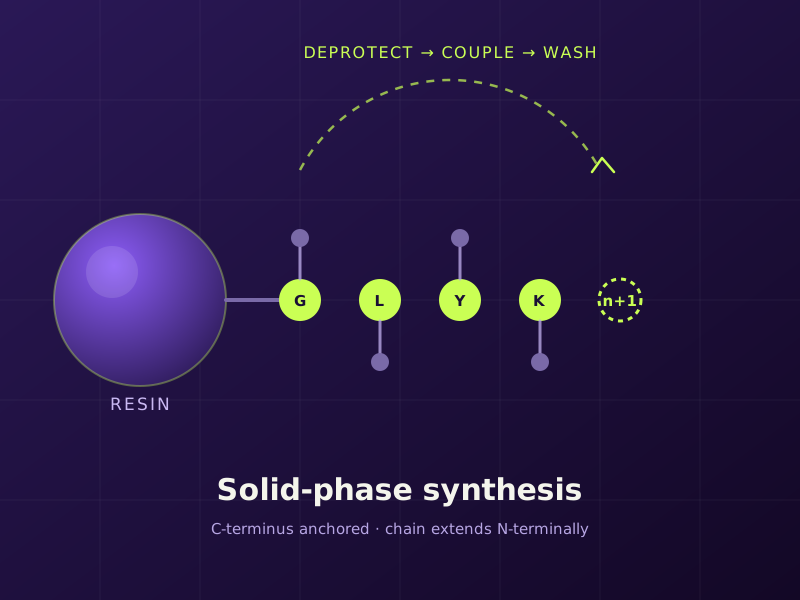
Merrifield's proposal was to attach the first amino acid (by its C-terminus) to an insoluble polystyrene bead. The growing chain stays bound to that bead throughout. Reagents are dissolved in solvent and poured over it; when the reaction is done, the solvent is simply drained away.
Purification stops being a chemical problem and becomes a plumbing one.
Because separation is now filtration, you can use a large excess of reagent to drive each coupling nearly to completion, something you would never do in solution, where the excess becomes tomorrow's purification headache. That single change is what made peptide synthesis automatable.
Each residue is added by the same three-step loop:
Side chains carry their own, more robust protecting groups so they cannot participate. Those come off at the end, in the same step that cleaves the finished chain from the resin.
A synthesiser runs this loop unattended. A 30-residue peptide is 30 cycles, roughly overnight.
The catch is compounding. Suppose each coupling proceeds with 99% efficiency, very good in practice. After 30 cycles the fraction of chains that received every residue correctly is 0.99³⁰, or about 74%. Drop to 98% per step and it falls to 55%.
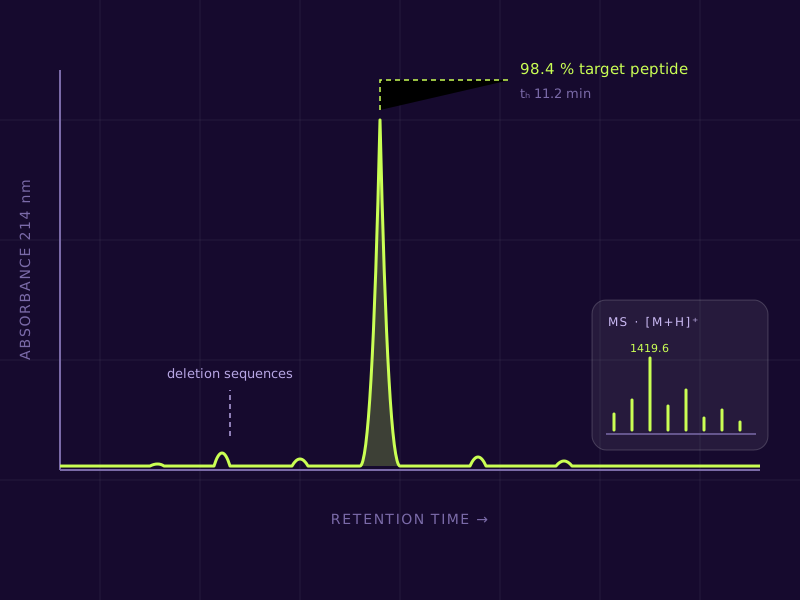
The missing quarter to half is not waste in the ordinary sense. Those chains are still there, still attached to beads, still being carried through every subsequent cycle. They emerge at the end as deletion sequences : peptides identical to the target except for one absent residue.
Doubling the residue count does not double the price. It reduces the yield of correct chains and increases the burden on purification, both at once.
Deletion sequences are the largest category, but not the only one:
The crude product goes through preparative reverse-phase HPLC, which separates by hydrophobicity. A deletion sequence missing a bulky hydrophobic residue behaves differently enough from the target to be separated cleanly.
A deletion missing a small residue such as glycine, in the middle of a long chain, may not. Neither will a racemised diastereomer, in many cases. This is the practical limit of the technique, and the reason a purity figure needs a method attached to be meaningful.
Two reasons, both practical.
First, it explains the price structure of the field. Peptide medicines are expensive not because of exotic ingredients but because stepwise chemistry has an unforgiving yield curve and the purification is genuinely difficult.
Second, it explains why "99% pure" is an incomplete statement. Pure by which method, at which wavelength, against which impurity classes? A certificate reporting HPLC purity alone has said nothing about stereochemistry, nothing about endotoxin, and nothing about how much of the vial's weight is peptide rather than water and counter-ions.
Those are separate tests, and they are the ones most often missing. We cover them in Part 06 of the foundations course.
This article describes how peptides are manufactured. It is not a guide to evaluating any particular product for personal use, and nothing here should be read as suggesting that a sufficiently good certificate makes an unapproved compound safe to take.
What happens between the injection site and the receptor, and the four ways developers extend the journey.
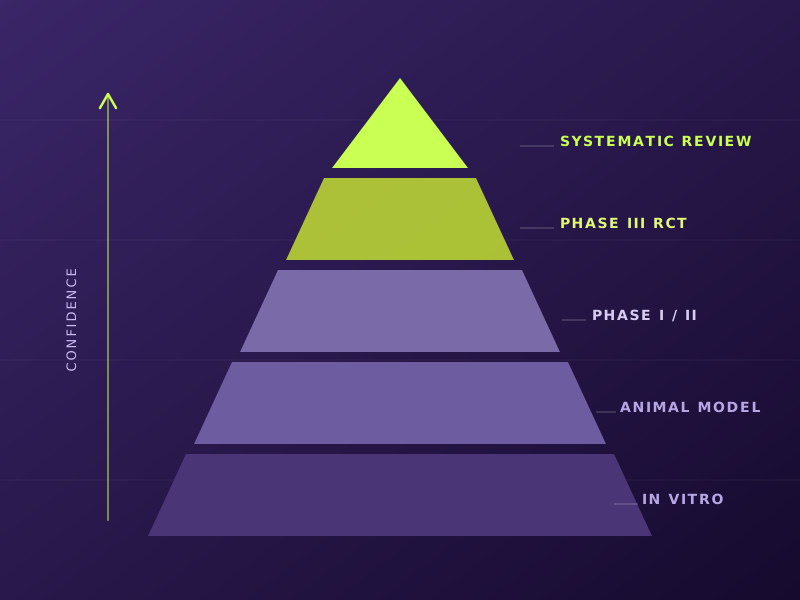
The four tiers, the criteria behind each, and worked examples of the reasoning.
Twenty-two entries with mechanism, regulatory status and an explicit evidence tier.