Search for peptides for weight loss and you will find a long list: semaglutide, tirzepatide, retatrutide, cagrilintide, AOD-9604, MOTS-c, CJC-1295 and various combinations sold as fat loss stacks. They are usually presented as if the evidence behind them were roughly equal. It is not. Some are licensed medicines backed by large randomised trials, some are drugs still in development, and some have little or no convincing evidence of meaningful weight loss in people. Answering which peptides for weight loss actually work starts with separating those groups.
What is a weight loss peptide?
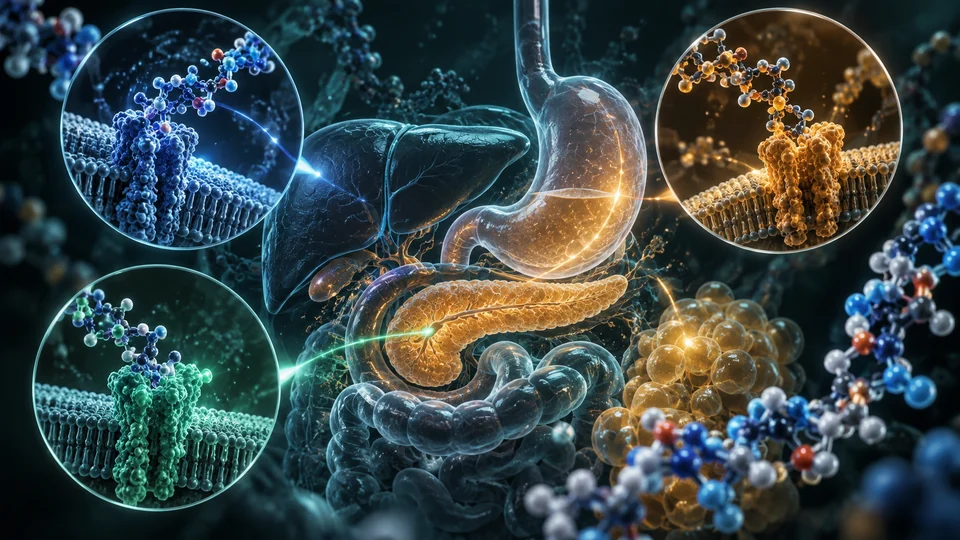
There is no official scientific category called weight loss peptides. The phrase is mostly a search term, covering peptide medicines and experimental compounds that may affect appetite, fullness, blood glucose, how fast the stomach empties, energy expenditure or body composition. The most successful modern examples work through hormones involved in the body's response to food, and that is where GLP-1 comes in.
Why GLP-1 changed weight loss treatment
GLP-1 is a natural hormone released from the gut after eating. Among other effects, it increases the feeling of fullness and reduces appetite. Natural GLP-1 lasts only a couple of minutes in the blood, so drug developers created molecules that activate the GLP-1 receptor for far longer. That gave us liraglutide and then semaglutide. Tirzepatide added activity at a second receptor, GIP, and retatrutide is being tested with a third target, the glucagon receptor.
| Compound | Mechanism | Half life | UK status | Evidence |
|---|---|---|---|---|
| Semaglutide | Semaglutide is an analogue of glucagon like peptide-1 (GLP-1), an incretin hormone released from intestinal L-cells after eating. | Approximately 165 hours (about 7 days) after subcutaneous administration, supporting once weekly dosing. | Licensed by the MHRA for type 2 diabetes and, at the 2.4 mg weekly dose, for weight management alongside diet and physical activity. | High-quality evidence |
| Tirzepatide | Tirzepatide is built on the backbone of glucose dependent insulinotropic polypeptide (GIP) rather than GLP-1, but it has been engineered to bind and activate both the GIP receptor and the GLP-1 receptor. | Approximately 5 days (roughly 117 hours) after subcutaneous administration, supporting once weekly dosing. | Licensed by the MHRA for type 2 diabetes and for weight management alongside a reduced calorie diet and increased physical activity. | High-quality evidence |
| Liraglutide | Liraglutide is a GLP-1 analogue that shares 97% sequence identity with native human GLP-1. | Approximately 13 hours after subcutaneous administration, consistent with once daily dosing. | Licensed by the MHRA for type 2 diabetes and, at 3.0 mg daily, for weight management alongside a reduced calorie diet and increased physical activity. | High-quality evidence |
| Retatrutide | Retatrutide is a single synthetic peptide agonist at three class B G-protein coupled receptors: the GIP receptor, the GLP-1 receptor and the glucagon receptor. | Approximately 6 days after subcutaneous administration, as reported in phase 1 pharmacokinetic work, supporting once weekly dosing. | Not licensed by the MHRA. | Mixed evidence |
Semaglutide: strong human evidence
Semaglutide has one of the strongest evidence bases of any weight loss peptide Regulator approved indication. For weight management it is sold as Wegovy. In the STEP 1 trial, adults with overweight or obesity and without diabetes received lifestyle support plus either weekly semaglutide or placebo for 68 weeks; mean weight loss was 14.9% on semaglutide against 2.4% on placebo Human 1. A much larger programme has since tested it on heart, kidney and liver outcomes, and in June 2026 the MHRA approved a semaglutide tablet for weight management 2.
Not every semaglutide product is licensed for weight loss. Wegovy is licensed for weight management, while Ozempic and Rybelsus are licensed for type 2 diabetes.
Tirzepatide: more average weight loss in trials
Tirzepatide activates GIP and GLP-1 receptors. The phase 3 SURMOUNT-1 trial enrolled 2,539 adults with obesity, or overweight with a weight related condition, and without diabetes. Over 72 weeks, mean weight loss was 15.0% to 20.9% depending on dose, against 3.1% on placebo Human 3.
It was later tested directly against semaglutide. In the 2025 SURMOUNT-5 trial, 751 adults with obesity lost a mean 20.2% of their starting weight on tirzepatide at 72 weeks, against 13.7% on semaglutide 4. Because people were randomised to one drug or the other, that comparison tells you far more than setting results from separate trials side by side. In the UK, tirzepatide is sold as Mounjaro and is authorised for weight management in qualifying adults.
Liraglutide: an older, proven option
Liraglutide is a daily GLP-1 receptor agonist, sold for weight management as Saxenda. It came before semaglutide and tirzepatide and produces less weight loss: in the SCALE trial, 3,731 adults without diabetes lost a mean 8.4 kg over 56 weeks, against 2.8 kg on placebo Human 5. It is licensed in the UK for weight management in adults and in adolescents from 12 years 6, and it has a cardiovascular outcome trial behind it in type 2 diabetes 7.
A newer medicine producing more weight loss does not erase the evidence behind an older one. Liraglutide belongs in a completely different evidence category from the experimental peptides sold online.
Retatrutide: very large results, not yet approved
Retatrutide targets GIP, GLP-1 and glucagon receptors. Its phase 2 obesity trial produced mean weight loss of up to 24.2% at 48 weeks Human 8, and in 2026 Lilly announced phase 3 results: in TRIUMPH-1, mean weight loss at 80 weeks reached 28.3% at the highest dose, one of the largest averages reported in a major obesity drug trial 9.
Is retatrutide the best peptide for weight loss, then? That needs care. It may well become an important medicine, but as of September 2026 it is investigational, and its phase 3 results have been announced by the company rather than published in full. Showing an effect in a trial is not the same as completing regulatory review. Retatrutide explained covers the trials and their limits.
Cagrilintide: an amylin partner for semaglutide
Cagrilintide is a long acting version of amylin, a hormone the pancreas releases with insulin that signals fullness. On its own it produced 6% to 10.8% weight loss at 26 weeks in a phase 2 trial Human 10. Its real development is as a combination with semaglutide: in the REDEFINE 1 trial the pair produced mean weight loss of about 20.4% at 68 weeks, against 3.0% on placebo 11. It is not licensed in the UK, alone or combined.
What about AOD-9604?
AOD-9604 is widely marketed online as a fat burning peptide. It is a 16 amino acid fragment of human growth hormone, developed in the 1990s on the theory that it keeps the hormone's fat burning effect without its growth effects. Its reputation online is far stronger than its evidence. After a small early trial, a larger 24 week trial failed to show significant weight loss against placebo at any dose, and development as an obesity drug was abandoned in 2007. That negative trial was never published in a peer reviewed journal.
The FDA has also stated that it holds little or no safety information on compounded AOD-9604, and has raised concerns about immune reactions, impurities and characterising the active ingredient 12. AOD-9604 has since been withdrawn from that FDA list after its nomination was withdrawn, which is a procedural step, not a finding of safety.
Being linked to fat metabolism in a laboratory is not the same as producing meaningful weight loss in a rigorous human trial.
What about growth hormone peptides?
CJC-1295, ipamorelin and similar compounds are sometimes sold as weight loss or body composition peptides, on the basis that they raise growth hormone. CJC-1295 has two published human studies, both from 2006 and both measuring hormone levels rather than weight or fat loss 13. Its clinical development was abandoned.
Changing growth hormone release is not the same as treating obesity, and none of these compounds has anything close to the evidence behind semaglutide or tirzepatide. The mechanism may sound plausible; the question is whether people actually lose meaningful fat safely, and that has not been tested.
What about MOTS-c?
MOTS-c is a small peptide encoded by mitochondrial DNA, and it often appears on weight loss peptide lists. In mice it prevented diet induced obesity and improved insulin sensitivity Animal 14. No completed trial has yet given it to people; the first registered human study is still recruiting. It does not belong in the same evidence category as the licensed incretin medicines. Promising biology is not proven weight loss.
AOD-9604
Limited evidenceMetabolic & incretin · 7 cited studies
Human trials exist, so this is not a purely preclinical compound, but the one adequately powered obesity study was negative and was never published; the only supporting positive human data appear in a non indexed journal produced by parties connected to the compound's commercial sponsors, and no peer reviewed randomised trial demonstrates efficacy for fat loss. The tier reflects the existence of human testing, not its success.
UK status. Not licensed by the MHRA for any indication.
MOTS-c
Preclinical onlyMetabolic & incretin · 6 cited studies
All evidence for administered MOTS-c comes from cell and animal work; human research is observational or genetic, and the only registered interventional human trial was verified as still recruiting with no results reported. Every citation was checked against PubMed or ClinicalTrials.gov.
UK status. Not licensed by the MHRA for any indication.
CJC-1295 with DAC
Limited evidenceGH secretagogues · 3 cited studies
Human data consist of two small, short, sponsor run pharmacodynamic studies in healthy volunteers measuring only growth hormone and IGF-1; the only other citation is a mouse study, no efficacy trial has ever been completed or published, and the single phase 2 trial was halted and never reported.
UK status. No UK marketing authorisation.
Licensed medicine vs research peptide
This is the distinction most often lost online. Compare two statements. One: "this molecule affects a pathway involved in fat metabolism". Two: "this medicine causes clinically significant, sustained weight loss in randomised human trials, with an acceptable balance of benefit and risk". The first can come from a single laboratory experiment. The second takes years and thousands of trial participants to establish.
Which weight loss peptides have the strongest evidence?
On the human evidence available today, the incretin medicines lead. Semaglutide has a very large evidence base. Tirzepatide has a large one too, and beat semaglutide for average weight loss in a direct trial. Liraglutide has solid but more modest weight loss data. Retatrutide is producing very strong results in development but is not approved, and neither is cagrilintide. Beyond these, the evidence drops away quickly for most compounds marketed online as weight loss peptides.
What about safety?
Effective does not mean free of risk. The most common side effects of GLP-1 based medicines are gastrointestinal: nausea, diarrhoea, constipation and vomiting. In January 2026 the MHRA strengthened its warnings on acute pancreatitis, including necrotising and fatal cases, with GLP-1 receptor agonists and dual GLP-1 and GIP receptor agonists 15. These are prescription medicines for a reason.
Weight management is also a long term question. Losing weight is one outcome; researchers also care about heart disease, diabetes risk, kidney health, tolerability, nutrition, muscle mass and what happens when treatment stops. Weight regain after stopping semaglutide is well documented.
Why an unapproved weight loss peptide is a different proposition
A licensed medicine comes through a controlled manufacturing chain. An online research product may not. With an unregulated vial there are two separate questions: does this molecule work, and is the substance in this vial actually what the label says? Even perfect evidence for a molecule would say nothing about the quality of an unregulated product claiming to contain it.
Frequently asked questions
What is the best peptide for weight loss?
On current human evidence, the strongest results among licensed medicines come from tirzepatide and semaglutide, and tirzepatide produced more average weight loss in a direct comparison. Which, if any, is right for a person is a decision for a prescriber, not a trial ranking.
Do weight loss peptides sold online work?
Most have not been shown to. Several, such as AOD-9604, MOTS-c and CJC-1295, have little or no controlled human evidence of meaningful weight loss, and the products themselves are unregulated.
Is semaglutide a peptide?
Yes. It is a modified version of the gut hormone GLP-1, a chain of amino acids with a fatty acid attached so that it lasts about a week.
Is retatrutide available for weight loss in the UK?
No. It is not licensed, and in the UK it is available only inside clinical trials.
References
Studies marked "View study in BioRx" sit in the clinical studies index with their design and evidence grade.
- Wilding JPH et al. (2021). Once-Weekly Semaglutide in Adults with Overweight or Obesity. New England Journal of Medicine.PubMed · DOI · ClinicalTrials.gov · View study in BioRx
- MHRA, First GLP-1 tablet for weight loss approved in the UK, 11 June 2026
- Jastreboff AM et al. (2022). Tirzepatide Once Weekly for the Treatment of Obesity. New England Journal of Medicine.PubMed · DOI · ClinicalTrials.gov · View study in BioRx
- Aronne LJ et al. Tirzepatide as Compared with Semaglutide for the Treatment of Obesity. N Engl J Med 2025;393(1):26-36
- Pi-Sunyer X et al. (2015). A Randomized, Controlled Trial of 3.0 mg of Liraglutide in Weight Management. New England Journal of Medicine.PubMed · DOI · ClinicalTrials.gov · View study in BioRx
- Saxenda summary of product characteristics, electronic medicines compendium
- Marso SP et al. (2016). Liraglutide and Cardiovascular Outcomes in Type 2 Diabetes. New England Journal of Medicine.PubMed · DOI · ClinicalTrials.gov · View study in BioRx
- Jastreboff AM et al. (2023). Triple-Hormone-Receptor Agonist Retatrutide for Obesity - A Phase 2 Trial. New England Journal of Medicine.PubMed · DOI · ClinicalTrials.gov · View study in BioRx
- Eli Lilly and Company (sponsor announcement) (2026). TRIUMPH-1 phase 3 trial of retatrutide in obesity (sponsor topline announcement). Company press release / investor communication. Identifiers not yet verifiedView study in BioRx
- Lau DCW et al. (2021). Once-weekly cagrilintide for weight management in people with overweight and obesity: a multicentre, randomised, double-blind, placebo-controlled and active-controlled, dose-finding phase 2 trial. Lancet.PubMed · DOI · ClinicalTrials.gov · View study in BioRx
- Garvey WT et al. (2025). Coadministered Cagrilintide and Semaglutide in Adults with Overweight or Obesity. New England Journal of Medicine.PubMed · DOI · View study in BioRx
- FDA, Certain bulk drug substances for use in compounding that may present significant safety risks
- Teichman SL, Neale A, Lawrence B, Gagnon C, Castaigne JP, Frohman LA (2006). Prolonged stimulation of growth hormone (GH) and insulin-like growth factor I secretion by CJC-1295, a long-acting analog of GH-releasing hormone, in healthy adults. Journal of Clinical Endocrinology and Metabolism.PubMed · DOI · View study in BioRx
- Lee C et al. (2015). The mitochondrial-derived peptide MOTS-c promotes metabolic homeostasis and reduces obesity and insulin resistance. Cell Metabolism.PubMed · DOI · View study in BioRx
- MHRA Drug Safety Update, strengthened warnings on acute pancreatitis, 29 January 2026