Searches for retatrutide have surged with every new set of trial results, and the headline figures are impressive. As of September 2026, retatrutide is still an investigational medicine. Here is what is actually known.
What is retatrutide?
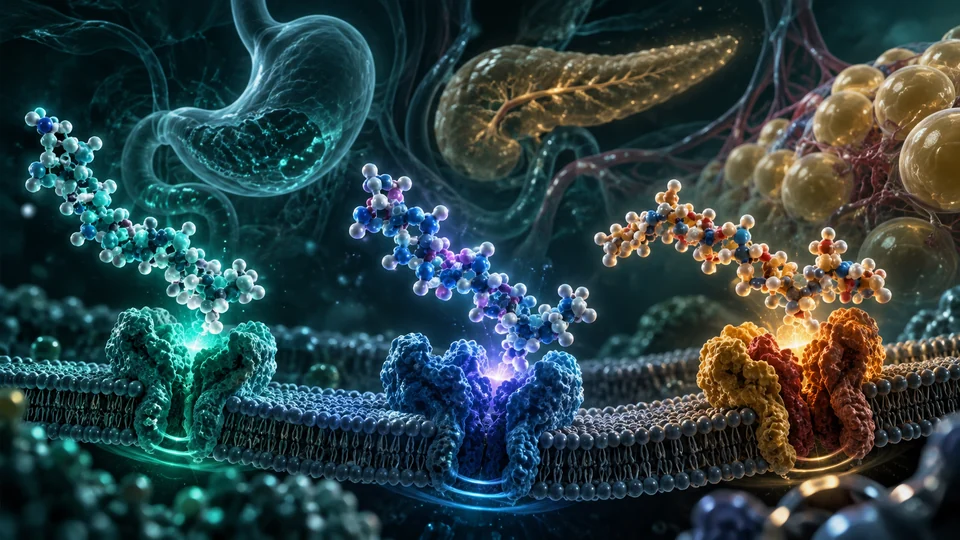
Retatrutide is an experimental peptide based medicine being developed by Eli Lilly under the code LY3437943. It is designed to activate three hormone receptors, GIP, GLP-1 and glucagon, which makes it a triple receptor agonist. It is being studied as a once weekly injection in a large programme covering obesity, type 2 diabetes and several obesity related conditions.
Is retatrutide a GLP-1?
Partly. It does activate the GLP-1 receptor, but calling it a GLP-1 drug leaves out two thirds of its intended pharmacology. Semaglutide mainly targets GLP-1 receptors, tirzepatide targets GIP and GLP-1, and retatrutide targets all three.
You may see it described as a "GLP-3". There is no GLP-3 receptor involved; it is a nickname, and Lilly describes it as scientifically inaccurate 1.
How does retatrutide work?
The interest lies less in the number of receptors than in what the three systems might contribute together.
GLP-1 signalling is involved in appetite, glucose dependent insulin release, glucagon control and how quickly the stomach empties. It is the same receptor system targeted by semaglutide.
GIP is another gut hormone released in response to food. Combining GIP and GLP-1 activity is already proven in the clinic through tirzepatide.
Glucagon is the unusual addition. Most people know it as the hormone that raises blood glucose, but glucagon signalling in the liver also increases energy expenditure, fat breakdown and fat burning, and reduces liver fat. The design logic is that the incretin arms cut how much energy comes in and hold glucose down, while the glucagon arm increases how much goes out.
Like semaglutide and tirzepatide, the molecule carries a fatty acid that binds albumin in the blood, which gives it a half life of about six days. Exactly how much each receptor contributes to the final effect is still being researched.
What did the original trial show?
The study that put retatrutide on the map was a phase 2 trial published in the New England Journal of Medicine in 2023 Human 2. It randomised 338 adults with obesity, or overweight with at least one weight related condition, to one of four doses or placebo for 48 weeks, double blind.
Mean weight change ranged from 8.7% at the lowest dose to 24.2% at the highest, against 2.1% on placebo, and at the higher doses weight was still falling at week 48. A companion trial in 281 people with type 2 diabetes showed large falls in HbA1c and weight, better than the comparator drug dulaglutide at higher doses 3.
Phase 2 asks whether a drug looks promising enough to test properly. The results were strong enough to justify a large phase 3 programme, called TRIUMPH, which asks the harder question of whether it still works at scale.
What did TRIUMPH-1 show?
In May 2026 Lilly released the headline results from TRIUMPH-1, a phase 3 obesity trial that randomised 2,339 people to retatrutide 4 mg, 9 mg or 12 mg, or placebo 4 5. Average weight change at 80 weeks, in the company's efficacy analysis:
| Group | Average weight change |
|---|---|
| Retatrutide 4 mg | 19.0% loss |
| Retatrutide 9 mg | 25.9% loss |
| Retatrutide 12 mg | 28.3% loss |
| Placebo | 2.2% loss |
Among people on 12 mg, 45.3% lost at least 30% of their body weight. A planned extension followed a subgroup with a starting BMI of 35 or more to 104 weeks, where the 12 mg group reached an average 30.3% reduction.
Does that mean retatrutide causes 30% weight loss?
Not quite. The 30.3% figure comes from one subgroup, in an extension of the trial, under one particular analysis. It does not mean everyone who takes retatrutide loses 30% of their body weight. People respond differently: some lose considerably more, others less, and some stop treatment. Trial averages are useful for comparing groups; they are not predictions for individuals.
What about people with type 2 diabetes and heart disease?
In July 2026 Lilly announced two more phase 3 results 6. In TRIUMPH-2, adults with type 2 diabetes and obesity or overweight lost up to 20.8% of body weight at 80 weeks on the highest dose, with HbA1c falling by up to 1.6 percentage points. In TRIUMPH-3, adults with a BMI of 35 or more and established cardiovascular disease lost up to 22.6% at 80 weeks.
As with all sponsor announcements, the full peer reviewed papers matter. A press release can report a trial accurately and still give scientists far less than a complete paper: no full safety tables, no subgroup analyses, no independent statistical review. BioRx gives company announcements no weight in its evidence grade until the trials are published.
Is retatrutide better than tirzepatide?
A direct comparison has not been done. Retatrutide has produced higher headline weight loss in its own trials than tirzepatide did in several of its trials, which makes a head to head study very interesting. Until people are randomised to one or the other under the same protocol, though, differences between separate studies have to be read with care. Starting weights, populations, trial lengths, analysis methods and dropout rates all move headline figures.
So "retatrutide looks extremely potent" is supported by the evidence. "Retatrutide has been proven better than tirzepatide" is not, yet. Semaglutide vs tirzepatide vs retatrutide sets out what has and has not been compared.
What are retatrutide's side effects?
Mostly gastrointestinal, and more frequent at higher doses. In TRIUMPH-1, Lilly reported that on 12 mg, 42.4% of people had nausea, 32.0% diarrhoea, 26.1% constipation and 25.3% vomiting, with lower rates on placebo.
One less familiar signal was dysaesthesia, an abnormal skin sensation such as tingling or altered touch. It was reported in 12.5% of people on 12 mg against 0.9% on placebo, and Lilly described the cases as generally mild to moderate. Phase 2 had also shown a dose dependent rise in heart rate, peaking around week 24, whose long term significance is unknown.
In TRIUMPH-1, 11.3% of the 12 mg group stopped treatment because of side effects, against 4.9% on placebo. A drug's effect cannot be separated from how well people tolerate it.
Is retatrutide approved?
No. As of September 2026 retatrutide has not been approved by the MHRA, the FDA or any other major regulator. In the UK it is available only to people taking part in a registered clinical trial, and supplying it to the public falls outside the Human Medicines Regulations 2012. It is also prohibited in sport under the WADA category for non approved substances.
Can you buy retatrutide online?
Products labelled retatrutide are sold by various online vendors. That does not make them Lilly's clinical trial medicine. The real product is still investigational, and anything bought outside an authorised trial has not been through the supply controls attached to the clinical programme. A label saying retatrutide cannot confirm the identity, strength, purity or sterility of what is in the vial, or whether it contains retatrutide at all. Lilly itself warns that retatrutide is not approved anywhere and that products sold outside its trials cannot be verified for safety, purity or dose 7.
When will retatrutide be available?
There is no confirmed launch date. In July 2026 Lilly said it plans to submit a licence application to the US FDA in the first quarter of 2027. Submission is not approval, regulators still have to review the evidence, and the UK timeline may differ from the US one.
Why retatrutide matters even if it never reaches the market
Drug development fails often, and no investigational medicine should be treated as a certainty. But retatrutide has already shown something important: acting on GIP, GLP-1 and glucagon signalling at once can produce very large weight loss in controlled human trials. That is likely to shape the next generation of metabolic medicines whatever happens to this particular molecule.
Retatrutide
Mixed evidenceMetabolic & incretin · 3 cited studies
Two consistent, well conducted phase 2 randomised placebo controlled trials are published and both were verified against PubMed, but no phase 3 report has been peer reviewed or published, no outcome data exist, and the compound is not approved by any regulator. Phase 3 topline announcements are sponsor communications and carry no independent tier weight.
UK status. Not licensed by the MHRA.
Frequently asked questions
What is retatrutide?
An investigational weekly injection that activates the GIP, GLP-1 and glucagon receptors, developed by Eli Lilly for obesity and type 2 diabetes.
Is retatrutide approved in the UK?
No. It is not licensed by the MHRA or any other regulator, and in the UK it is available only inside clinical trials.
How much weight did people lose in the trials?
In the published phase 2 trial, 8.7% to 24.2% at 48 weeks depending on dose, against 2.1% on placebo. In the phase 3 TRIUMPH-1 trial, Lilly has announced 19.0% to 28.3% at 80 weeks, against 2.2% on placebo; the full paper has not yet been published.
Is retatrutide the same as GLP-3?
GLP-3 is an internet nickname for retatrutide. There is no GLP-3 hormone or receptor, and Lilly calls the name scientifically inaccurate.
Is retatrutide sold online the same as the drug in the trials?
No. Trial material is made to pharmaceutical standards under regulatory oversight. Online material is unregulated, and its identity, purity and strength are unverified.
References
Studies marked "View study in BioRx" sit in the clinical studies index with their design and evidence grade.
- Lilly, What to know about retatrutide
- Jastreboff AM et al. (2023). Triple-Hormone-Receptor Agonist Retatrutide for Obesity - A Phase 2 Trial. New England Journal of Medicine.PubMed · DOI · ClinicalTrials.gov · View study in BioRx
- Rosenstock J et al. (2023). Retatrutide, a GIP, GLP-1 and glucagon receptor agonist, for people with type 2 diabetes: a randomised, double-blind, placebo and active-controlled, parallel-group, phase 2 trial conducted in the USA. Lancet.PubMed · DOI · View study in BioRx
- Eli Lilly and Company (sponsor announcement) (2026). TRIUMPH-1 phase 3 trial of retatrutide in obesity (sponsor topline announcement). Company press release / investor communication. Identifiers not yet verifiedView study in BioRx
- Lilly, TRIUMPH-1 phase 3 topline results, 21 May 2026
- Lilly, TRIUMPH-2 and TRIUMPH-3 phase 3 results, 23 July 2026
- Lilly Medical, Is retatrutide available in the consumer market?