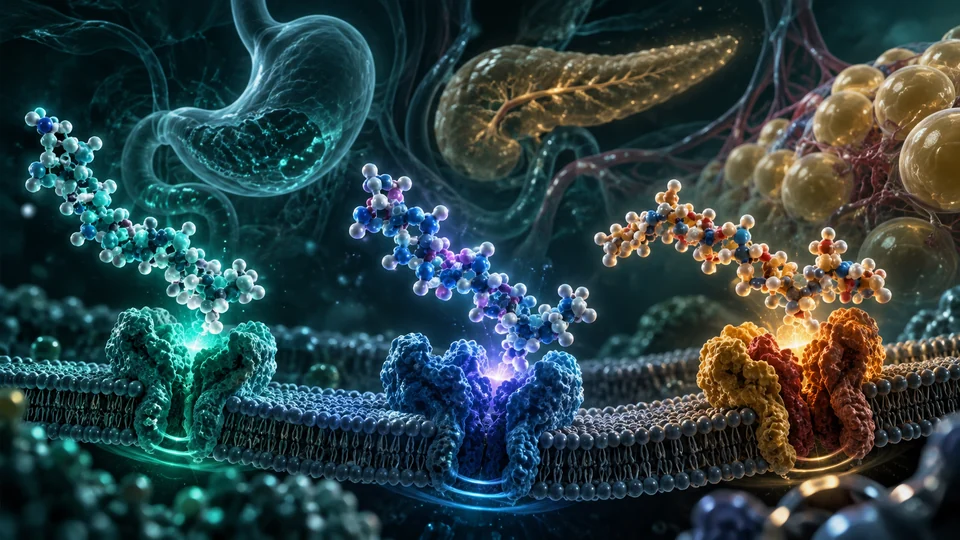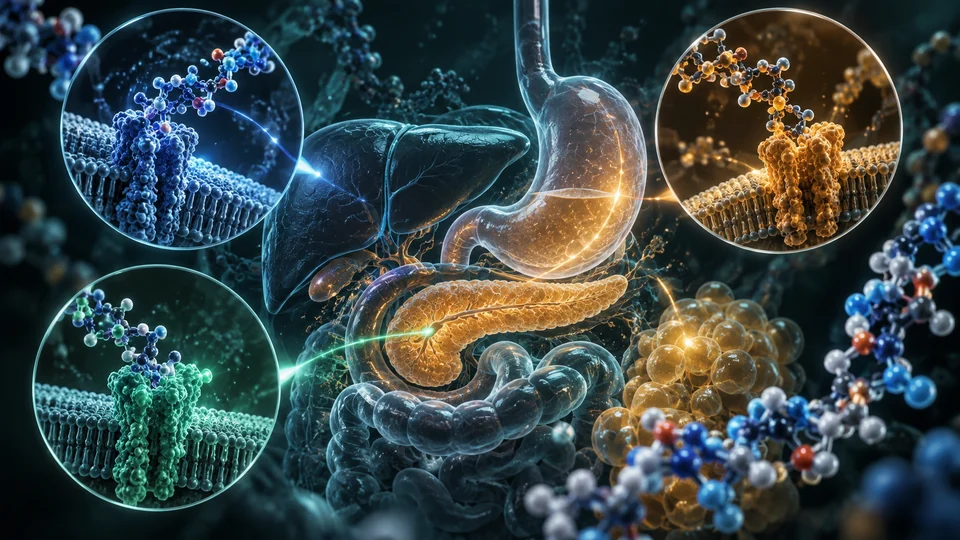
For several years, weight loss drug development has largely revolved around one family of hormones, the incretins. Semaglutide targets the GLP-1 receptor, tirzepatide targets GLP-1 and GIP, and retatrutide adds glucagon. Cagrilintide takes a different route. Instead of adding another incretin receptor, it targets a hormone system called amylin, and combining it with semaglutide gives CagriSema. The idea is to use two different appetite regulating systems at once. The trials show that this approach produces substantial weight loss, but the comparison with tirzepatide has turned out to be the most interesting part of the story.
What is amylin?
Amylin is a hormone released from the beta cells of the pancreas alongside insulin when you eat. It contributes to the feeling of fullness and helps coordinate the body's response to a meal; in simple terms, it helps tell the brain that food has arrived. That makes it an attractive target for weight management medicines. Natural human amylin makes a poor drug, because it tends to clump into insoluble fibres and does not last long in the body, so researchers have developed synthetic versions designed to stay stable and active for longer. An older, short acting one, pramlintide, has been approved in the US since 2005 as an add on to mealtime insulin for diabetes, but was never licensed in the UK. Cagrilintide is a newer, long acting design.
What is cagrilintide?
Cagrilintide is a long acting amylin analogue developed by Novo Nordisk. A fatty acid attached to the molecule lets it bind reversibly to albumin in the blood, giving it a half life of about a week, which is why it is given as a once weekly injection in trials. It activates the family of amylin receptors and the related calcitonin receptor, and its main effects are in the brainstem areas that signal the end of a meal. It seems to make meals end sooner rather than simply reducing hunger between them Mechanistic. Work in rodents published in 2025 traced its weight lowering effect to two specific amylin receptors in the brain Animal 1. Unlike semaglutide, it does not work through the GLP-1 receptor, which is what makes it scientifically interesting: it offers a second, separate lever on appetite.
The first large test of cagrilintide on its own was a phase 2 trial in 706 adults with overweight or obesity and without diabetes Human 2. At 26 weeks, average weight loss across five doses ranged from 6.0% to 10.8%, compared with 3.0% on placebo, and the highest dose produced slightly more weight loss than liraglutide, an established GLP-1 medicine (10.8% against 9.0%). The most common side effects were gastrointestinal problems and injection site reactions. That gave cagrilintide real human weight loss data, but Novo Nordisk's development since then has concentrated on combining it with semaglutide rather than taking it forward alone.
What is CagriSema?
CagriSema is cagrilintide and semaglutide given together in a single weekly injection. Semaglutide activates the GLP-1 receptor; cagrilintide activates amylin signalling. One way to picture it is two separate volume controls feeding into the same system: they are not identical signals, but both push towards fullness. An early phase 1b trial in 95 people found the two could be given together without an unfavourable interaction between them Human 3, which cleared the way for the phase 3 programme, called REDEFINE for weight management and REIMAGINE for type 2 diabetes.
What did REDEFINE 1 show?
REDEFINE 1 was a 68 week, double blind phase 3 trial in 3,417 adults with obesity, or with overweight plus at least one weight related condition, and without diabetes Human 4. Participants received CagriSema, semaglutide alone, cagrilintide alone or placebo, all alongside lifestyle advice.
Trials report weight loss in two ways. The treatment policy analysis counts everyone as randomised, whether or not they stayed on the drug, and is closer to real world use. The trial product analysis estimates what happens if everyone keeps taking it as intended, which gives bigger numbers. Both come from the same trial:
| Treatment | Treatment policy analysis | Trial product analysis |
|---|---|---|
| CagriSema | 20.4% | 22.7% |
| Semaglutide alone | 14.9% | 16.1% |
| Cagrilintide alone | 11.5% | 11.8% |
| Placebo | 3.0% | 2.3% |
Average weight loss at 68 weeks in REDEFINE 1 (Garvey et al., NEJM 2025).
That is strong evidence that adding cagrilintide to semaglutide increases average weight loss: the combination beat semaglutide alone by 5.5 percentage points on the treatment policy analysis. It also shows that cagrilintide on its own produced meaningful weight loss over 68 weeks, so it should not be thought of as an inactive partner added to improve semaglutide. It has its own effect.
What about people with type 2 diabetes?
REDEFINE 2 tested CagriSema against placebo in 1,206 adults with type 2 diabetes and overweight or obesity, over 68 weeks Human 5. Mean weight loss was 13.7% against 3.4% with placebo, and 73.5% of people on CagriSema reached an HbA1c of 6.5% or lower, against 15.9% on placebo.
REIMAGINE 2, a larger diabetes trial in 2,728 people, compared CagriSema directly with semaglutide. Novo Nordisk announced headline results in February 2026 Human 6. At 68 weeks, assuming people stayed on treatment, CagriSema lowered HbA1c by 1.91 percentage points against 1.76 with semaglutide, and reduced body weight by 14.2% against 10.2%. Counting everyone regardless of adherence, the figures were 1.80 against 1.68 points, and 12.9% against 9.2%. The difference in blood sugar control was small; the difference in weight was larger. These are company figures from an announcement rather than a full peer reviewed paper.
CagriSema vs tirzepatide: what happened?
Early on, 20% or more weight loss sounded like a clear step beyond semaglutide. But the question clinicians really wanted answered was how CagriSema compared with tirzepatide, which already produces very large weight reductions. REDEFINE 4 was designed to answer it, and Novo Nordisk announced the results in February 2026 Human 7.
The trial randomised 809 adults with obesity and at least one related condition to CagriSema or tirzepatide for 84 weeks. It was open label, meaning participants and doctors knew which drug was being given. The primary aim was to show that CagriSema was not meaningfully worse than tirzepatide, known as non inferiority, and it failed to show that. Assuming people stayed on treatment, weight loss was 23.0% with CagriSema against 25.5% with tirzepatide. Counting everyone regardless of adherence, it was 20.2% against 23.6%. The company said CagriSema appeared safe and well tolerated, with mostly mild to moderate gastrointestinal side effects that eased over time, and that a phase 3 trial of a higher dose version of CagriSema was planned to start in the second half of 2026.
That is a very different kind of evidence from lining up numbers from separate trials. It was a direct comparison, and tirzepatide came out ahead.
Does that mean tirzepatide is simply better?
It means tirzepatide produced greater average weight loss in this head to head trial. It does not settle every clinical question. People respond differently, and tolerability, blood sugar control, cardiovascular outcomes, long term maintenance and future doses or formulations all matter. What it does mean is that it would be inaccurate to ignore REDEFINE 4 and suggest CagriSema has been shown to beat tirzepatide for weight loss. It has not.
There is also a direct trial of the two established drugs. SURMOUNT-5 randomised 751 adults with obesity and without diabetes to tirzepatide or semaglutide, each at the highest dose people could tolerate, for 72 weeks Human 8. Average weight loss was 20.2% with tirzepatide against 13.7% with semaglutide. So, as of 2026, the clearest head to head evidence is that tirzepatide beat semaglutide in SURMOUNT-5 and also produced more weight loss than CagriSema in REDEFINE 4, while CagriSema beat semaglutide alone in REDEFINE 1. Those are averages from trials, not predictions for any one person; semaglutide vs tirzepatide vs retatrutide covers the incretin side in more depth.
| Compound | Mechanism | Half life | UK status | Evidence |
|---|---|---|---|---|
| Cagrilintide | Cagrilintide is an acylated analogue of human amylin (islet amyloid polypeptide), a 37-amino acid hormone co secreted with insulin from pancreatic beta cells in response to meals. | Approximately 7 to 8 days after subcutaneous administration, supporting once weekly dosing. | Not licensed by the MHRA, alone or in combination. | Mixed evidence |
| Semaglutide | Semaglutide is an analogue of glucagon like peptide-1 (GLP-1), an incretin hormone released from intestinal L-cells after eating. | Approximately 165 hours (about 7 days) after subcutaneous administration, supporting once weekly dosing. | Licensed by the MHRA for type 2 diabetes and, at the 2.4 mg weekly dose, for weight management alongside diet and physical activity. | High-quality evidence |
| Tirzepatide | Tirzepatide is built on the backbone of glucose dependent insulinotropic polypeptide (GIP) rather than GLP-1, but it has been engineered to bind and activate both the GIP receptor and the GLP-1 receptor. | Approximately 5 days (roughly 117 hours) after subcutaneous administration, supporting once weekly dosing. | Licensed by the MHRA for type 2 diabetes and for weight management alongside a reduced calorie diet and increased physical activity. | High-quality evidence |
What are the side effects?
As with other modern obesity medicines, gastrointestinal effects are common. In REDEFINE 1, 79.6% of people on CagriSema reported gastrointestinal side effects, such as nausea, vomiting, diarrhoea, constipation or abdominal pain, against 39.9% on placebo; most were temporary and mild to moderate 4. In REDEFINE 2 the figures were 72.5% against 34.4% 5. Two drugs acting on fullness at once would be expected to add up in this way. Because amylin receptors overlap with the calcitonin receptor, effects on calcium and bone have been raised as a theoretical question, but they have not emerged as a problem in the trials so far. No cardiovascular outcome trial of CagriSema has been published. The largest possible weight loss figure is not automatically the right choice for every person, which is a judgement for a prescriber.
Is CagriSema approved?
No. Novo Nordisk submitted CagriSema for weight management to the US FDA on 18 December 2025 9, and in its February 2026 REDEFINE 4 announcement said it expected an FDA decision by late 2026. Submission is not approval. The FDA's page on unapproved weight loss drugs, updated on 1 September 2026, says cagrilintide cannot be used in compounding under US federal law, is not a component of any FDA approved drug and has not been found safe and effective for any condition 10.
In the UK, neither cagrilintide nor CagriSema is licensed by the MHRA, and the only lawful access is through a registered clinical trial. Cagrilintide sold online as a research chemical is an unlicensed medicine of unverified content, not the material used in the trials, and supplying it for human use falls outside the Human Medicines Regulations 2012. For athletes, cagrilintide is not named on the WADA Prohibited List, but as a substance not approved for human use it falls under class S0, non approved substances, and is prohibited at all times.
Cagrilintide
Mixed evidenceMetabolic & incretin · 5 cited studies
A single published phase 2 monotherapy dose finding trial supports cagrilintide alone, with the substantial phase 3 evidence relating to the fixed dose combination with semaglutide rather than to cagrilintide as an individual agent; all five citations were verified against PubMed, but no regulatory approval and no outcome data yet exist.
UK status. Not licensed by the MHRA, alone or in combination.
Semaglutide
High-quality evidenceMetabolic & incretin · 6 cited studies
Multiple large, replicated, placebo controlled randomised outcome trials with hard endpoints across diabetes, obesity, cardiovascular disease, kidney disease and liver disease, all independently verified against PubMed and ClinicalTrials.gov, supported by approved regulatory labelling in the US, UK and EU.
UK status. Licensed by the MHRA for type 2 diabetes and, at the 2.4 mg weekly dose, for weight management alongside diet and physical activity.
The BioRx conclusion
Cagrilintide is a different direction in obesity drug development. Instead of adding another incretin receptor, it uses the amylin system, and it produces meaningful weight loss on its own. Combined with semaglutide as CagriSema, it clearly produced more weight loss than semaglutide alone in phase 3 trials, with average losses above 20% in people without diabetes. But the most important 2026 result is equally clear: in their head to head trial, CagriSema did not keep pace with tirzepatide. That does not make CagriSema a failure. It is a reminder that drug development is not a ladder where every new combination automatically becomes the strongest option. Until a regulator approves it, CagriSema remains an investigational medicine.
Frequently asked questions
What is the difference between cagrilintide and semaglutide?
Cagrilintide is a long acting version of the hormone amylin, while semaglutide mimics GLP-1. Both reduce appetite, but through different receptors, which is why they have been combined as CagriSema.
How much weight did people lose on CagriSema?
In REDEFINE 1, adults without diabetes lost an average of 20.4% of their body weight at 68 weeks counting everyone, or 22.7% assuming they stayed on treatment. In people with type 2 diabetes in REDEFINE 2 the average was 13.7%.
Is CagriSema better than tirzepatide?
Not on the evidence so far. In the REDEFINE 4 head to head trial, tirzepatide produced more weight loss (25.5% against 23.0% assuming people stayed on treatment) and CagriSema failed its primary goal of showing non inferiority.
Does cagrilintide work on its own?
Yes, to a degree. It produced 6.0% to 10.8% weight loss at 26 weeks in a phase 2 trial, and 11.5% at 68 weeks in REDEFINE 1 counting everyone, but it is being developed mainly as part of CagriSema.
Is cagrilintide legal in the UK?
It is not licensed by the MHRA for any use, alone or in CagriSema, and is available lawfully only inside clinical trials.
References
Studies marked "View study in BioRx" sit in the clinical studies index with their design and evidence grade.
- Carvas AO et al. (2025). Cagrilintide lowers bodyweight through brain amylin receptors 1 and 3. EBioMedicine.PubMed · DOI · View study in BioRx
- Lau DCW et al. (2021). Once-weekly cagrilintide for weight management in people with overweight and obesity: a multicentre, randomised, double-blind, placebo-controlled and active-controlled, dose-finding phase 2 trial. Lancet.PubMed · DOI · ClinicalTrials.gov · View study in BioRx
- Enebo LB et al. (2021). Safety, tolerability, pharmacokinetics, and pharmacodynamics of concomitant administration of multiple doses of cagrilintide with semaglutide 2.4 mg for weight management: a randomised, controlled, phase 1b trial. Lancet.PubMed · DOI · View study in BioRx
- Garvey WT et al. (2025). Coadministered Cagrilintide and Semaglutide in Adults with Overweight or Obesity. New England Journal of Medicine.PubMed · DOI · View study in BioRx
- Davies MJ et al. (2025). Cagrilintide-Semaglutide in Adults with Overweight or Obesity and Type 2 Diabetes. New England Journal of Medicine.PubMed · DOI · View study in BioRx
- Novo Nordisk company announcement, REIMAGINE 2 headline results, 2 February 2026
- Novo Nordisk company announcement, REDEFINE 4 headline results, 23 February 2026
- Aronne LJ et al. Tirzepatide as Compared with Semaglutide for the Treatment of Obesity. N Engl J Med 2025;393(1):26-36
- Novo Nordisk, CagriSema submitted to the US FDA, 18 December 2025
- FDA, FDA's concerns with unapproved GLP-1 drugs used for weight loss