MOTS-c is a short peptide made from instructions carried in mitochondrial DNA rather than in the cell nucleus. In mice it acts on cellular energy sensing and improves several metabolic and physical measures, which is why it is sold online as a longevity and exercise peptide. In people, the evidence consists of measurements of the MOTS-c the body already makes and a handful of genetic studies. No completed trial has given MOTS-c to humans, so its effects and its safety as a treatment are unknown.
What does "mitochondrial derived peptide" mean?
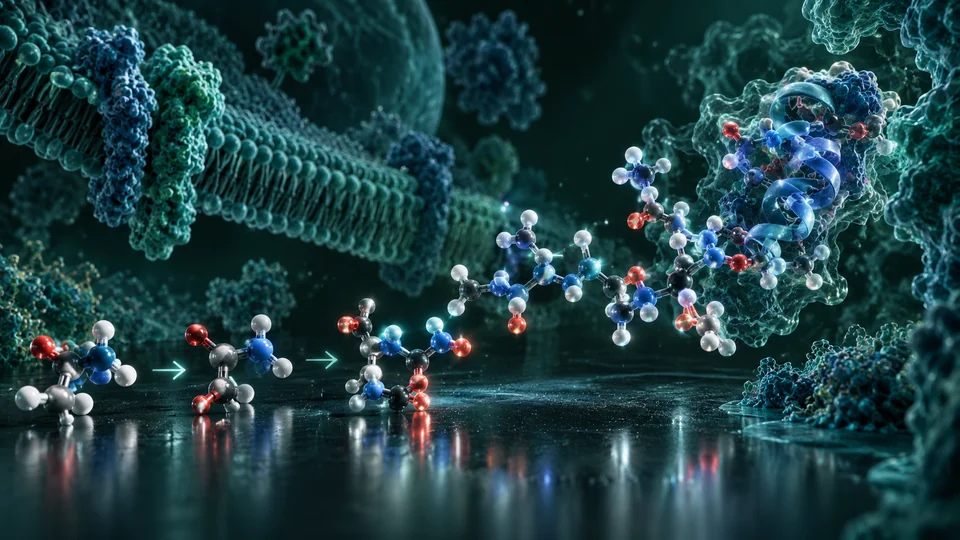
Mitochondria are often called the power stations of the cell because they turn nutrients into usable energy. They also carry their own small circle of DNA, separate from the genetic material in the nucleus. For decades that genome was thought to encode only a small, fixed set of proteins and RNA molecules needed for energy production.
That picture changed when researchers found short stretches of mitochondrial DNA that can produce small signalling peptides. Humanin was the first. In 2015 researchers reported a second: a short open reading frame inside the mitochondrial 12S rRNA gene that encodes a 16 amino acid peptide they named MOTS-c, for mitochondrial open reading frame of the 12S rRNA type c Mechanistic 1. The finding mattered because it suggested mitochondria do more than make energy. They can also send chemical messages to the rest of the cell and, through the blood, to the rest of the body.
How does MOTS-c work?
Most of the research points to cellular energy sensing. The original paper found that MOTS-c acts mainly on skeletal muscle, where it inhibits the folate cycle and the purine synthesis tied to it. That leads to AMPK activation In vitro Animal 1. AMPK works like a fuel gauge: when energy runs low it switches the cell towards taking up glucose and burning fat, and away from storing it.
Later work has added other candidate targets. A 2024 study reported that MOTS-c binds and activates an enzyme called CK2 in muscle, a more direct target than the folate cycle route Mechanistic 2. A 2026 study in two strains of genetically modified mice found that MOTS-c improved how efficiently muscle mitochondria produced energy, and that the effect depended on both PGC-1α and AMPK Animal 3. The FDA's own review in 2026 still described the molecular targets behind MOTS-c's effects as unknown, and noted that the animal work has not established how the response changes with dose 4. The mechanism is interesting. It is not the same thing as a clinical effect.
What did the original mouse research show?
In the 2015 Cell Metabolism paper, MOTS-c treatment in mice prevented the insulin resistance that develops with age and with a high fat diet, and prevented diet induced obesity Animal 1. Those results are why MOTS-c quickly became linked with obesity, type 2 diabetes and metabolic health.
Mouse metabolism research has produced many promising compounds that never became useful human medicines. Mice differ from people in body size, metabolic rate and lifespan, and experimental diets are designed to produce effects quickly. A result in a mouse is a reason to run a human trial, not a substitute for one.
Why is MOTS-c called an exercise peptide?
Because some of its effects in animals resemble changes produced by physical activity. A 2021 study in Nature Communications reported that MOTS-c improved physical performance in young, middle aged and old mice, and that treatment started late in life increased physical capacity and healthspan measures in old mice Animal 5. The same paper reported that exercise raised MOTS-c in human skeletal muscle and in the blood Human.
That work popularised the phrase "exercise mimetic". It needs context. Exercise affects the heart, blood vessels, bones, muscles, brain, mood and coordination at once. A substance that reproduces some of the molecular changes seen after exercise in mice has not been shown to reproduce the benefits of exercising, and no peptide should be assumed to replace it.
Does exercise raise MOTS-c in people?
Human studies have looked at this, with mixed results. In a study of 30 adults randomised to a single session of endurance exercise, resistance exercise or rest, endurance exercise raised circulating humanin, while MOTS-c showed only a trend towards an increase Human 6. In a secondary analysis of a trial in breast cancer survivors, a 16 week aerobic and resistance programme raised MOTS-c in non Hispanic white women but not in Hispanic women Human 7. A pilot comparison found lower MOTS-c in professional athletes than in sedentary controls Human 8.
The 2026 mouse study above also sampled blood entering and leaving a working leg in people during exercise and found no difference, which the authors took to suggest that muscle may not be where circulating MOTS-c comes from Human 3. MOTS-c is plainly part of human metabolism and exercise biology. How it is regulated is still being worked out.
What do blood levels tell us?
Many studies have measured MOTS-c in the blood of people with different conditions, and the pattern is not consistent. A cross sectional study of 225 people found lower serum MOTS-c in type 2 diabetes than in controls, with levels falling as age, HbA1c and glucose rose Human 9. A 2026 study found the opposite direction in obesity: circulating MOTS-c was higher in 32 adults with obesity than in 22 lean controls, and in the 10 followed after bariatric surgery it did not change despite large falls in body mass index Human 10.
These are correlations. A low level in a disease may be a consequence of that disease rather than a cause, and a high level may be the body compensating. Only a treatment trial can show whether raising MOTS-c changes anything that matters to patients.
The Japanese gene variant
The most intriguing human evidence is genetic. A variant called m.1382A>C, found in Northeast Asian populations, changes one amino acid in MOTS-c. A 2015 report proposed it as one possible contributor to the high longevity of Japanese people Human 11. A 2021 meta analysis of three cohorts totalling 27,527 people found that men, but not women, carrying the variant had a higher prevalence of type 2 diabetes, with the effect seen in the least physically active men; in mice on a high fat diet the variant peptide lacked the benefits of normal MOTS-c Human Animal 12. Genetic associations like these support the idea that MOTS-c matters in human metabolism. They do not show what happens when synthetic MOTS-c is injected.
Has MOTS-c been tested as a treatment in people?
Not in any completed published trial. The nearest thing was CB4211, a modified analogue of MOTS-c developed by the US company CohBar. In a phase 1b study, 20 people with obesity and fatty liver disease received injections of CB4211 or placebo for four weeks. The company reported that CB4211 was well tolerated, with mild to moderate injection site reactions the most common adverse event, and that liver enzymes and glucose fell more than with placebo, while liver fat fell by a similar amount in both groups Human 13. These were company topline figures from a small, short study, and CB4211 is a different molecule from MOTS-c. In 2023 CohBar told investors it did not believe the formulation used in that study was suitable for further development and that efforts to improve it had not succeeded, before merging into a company focused on another developer's product candidates 14.
A randomised, placebo controlled phase 2 trial of MOTS-c itself in adults with prediabetes and overweight or obesity is registered in China and was recruiting in 2026, with no results reported 15. Until trials like that report, every claim about what injected MOTS-c does in a person is an extrapolation from mice.
Does MOTS-c help with weight loss or ageing?
Neither has been shown in humans. The mouse findings on diet induced obesity and on physical capacity in old age are interesting, but there is no human trial showing that MOTS-c produces meaningful weight loss, slows biological ageing, prevents age related disease or extends healthspan. That places it in a completely different evidence category from medicines such as semaglutide and tirzepatide, which have been tested in thousands of people in large randomised trials. Peptides for weight loss sets out that evidence.
Is MOTS-c safe?
Nobody knows. The FDA states that compounded MOTS-c may carry a significant risk of immune reactions for some routes, may be complicated by peptide related impurities, and that it has not identified any human exposure data on drug products containing MOTS-c by any route. As a result, it says, it lacks important information on whether MOTS-c would cause harm if given to humans 16. Its July 2026 briefing added that an in vitro study found MOTS-c is quickly broken down in human blood, which raises the question of whether injected MOTS-c reaches active concentrations at all 4.
People often read "made naturally by the body" as "safe to inject". The two are not the same. The body makes insulin and cortisol too, and too much of either causes serious harm. Amount, timing and location all matter, and a natural substance given as a drug still needs testing as a drug.
Legal status in the UK, the US and sport
MOTS-c is not a licensed medicine in the UK or anywhere else. The MHRA has not authorised any product containing it, and supplying an unlicensed medicine for human use falls outside the Human Medicines Regulations 2012. Labels such as "research use only" do not change that.
In the US, the FDA reviewed MOTS-c for possible use by compounding pharmacies in July 2026. Its briefing found no clinical studies of MOTS-c in humans, noted that it is not a component of any FDA approved drug, and proposed that it should not be added to the list of substances pharmacies may compound 4. The advisory committee voted to recommend it anyway, but those votes are recommendations and do not bind the FDA 17. A committee vote on compounding is not drug approval.
For athletes the position is clear. The World Anti-Doping Agency names MOTS-c on its Prohibited List as an AMPK activator under section S4.4.1, metabolic modulators, prohibited at all times 18.
MOTS-c
Preclinical onlyMetabolic & incretin · 6 cited studies
All evidence for administered MOTS-c comes from cell and animal work; human research is observational or genetic, and the only registered interventional human trial was verified as still recruiting with no results reported. Every citation was checked against PubMed or ClinicalTrials.gov.
UK status. Not licensed by the MHRA for any indication.
The BioRx conclusion
MOTS-c is one of the most interesting peptides in current research. It comes from mitochondrial DNA, it acts on the cell's energy sensing machinery, and mouse studies have produced striking results on insulin sensitivity, obesity and physical capacity. Human studies show that people make it, that its levels shift with disease and exercise, and that a gene variant affecting it is linked with diabetes risk in Japanese men.
What is missing is the evidence people actually want: a completed trial of MOTS-c given to humans. The only related molecule to reach people was a modified analogue in a four week study of 20 patients, and its developer did not take it further. The most accurate summary is fascinating mitochondrial biology with a strong animal record, while claims about human fat loss, performance and longevity remain unproven.
Frequently asked questions
Has MOTS-c been tested in humans?
Not as a treatment in any completed published study. Human research so far measures the MOTS-c people already make, or looks at a gene variant that alters it. A modified analogue, CB4211, was tested briefly in a small company study before development stalled, and a phase 2 trial of MOTS-c itself was recruiting in 2026 with no results.
Is MOTS-c an exercise mimetic?
It is a candidate, not an established one. Exercise can raise MOTS-c in human muscle and blood, and giving MOTS-c improved physical capacity in mice of several ages. No study has shown that a person gains fitness or metabolic benefit from receiving it.
Does low MOTS-c cause disease?
That has not been shown. Studies finding lower MOTS-c in type 2 diabetes, or higher levels in obesity, are cross sectional snapshots. The level may reflect the disease rather than drive it, and only a treatment trial can separate the two.
Is MOTS-c legal in the UK?
It is not a licensed medicine in the UK, so it cannot lawfully be sold or supplied as a medicine for human use under the Human Medicines Regulations 2012. Products sold online are unlicensed, and no regulator checks their content or purity.
Is MOTS-c banned in sport?
Yes. WADA names it on the Prohibited List under S4.4.1 as an AMPK activator, banned in and out of competition.
References
Studies marked "View study in BioRx" sit in the clinical studies index with their design and evidence grade.
- Lee C et al. (2015). The mitochondrial-derived peptide MOTS-c promotes metabolic homeostasis and reduces obesity and insulin resistance. Cell Metabolism.PubMed · DOI · View study in BioRx
- Kumagai H et al. (2024). MOTS-c modulates skeletal muscle function by directly binding and activating CK2. iScience.PubMed · DOI · View study in BioRx
- MOTS-c improves intrinsic muscle mitochondrial bioenergetic health and efficiency in a PGC-1α/AMPK-dependent manner, Free Radic Biol Med 2026
- FDA, Pharmacy Compounding Advisory Committee briefing on MOTS-c, July 2026
- Reynolds JC et al. (2021). MOTS-c is an exercise-induced mitochondrial-encoded regulator of age-dependent physical decline and muscle homeostasis. Nature Communications.PubMed · DOI · View study in BioRx
- von Walden F et al. Acute endurance exercise stimulates circulating levels of mitochondrial-derived peptides in humans, J Appl Physiol 2021
- Dieli-Conwright CM et al. Effect of aerobic and resistance exercise on the mitochondrial peptide MOTS-c in Hispanic and Non-Hispanic White breast cancer survivors, Sci Rep 2021
- The Effect of Chronic Endurance Exercise on Serum Levels of MOTS-c and Humanin in Professional Athletes, Rev Cardiovasc Med 2022
- Ramanjaneya M et al. Mitochondrial-Derived Peptides Are Down Regulated in Diabetes Subjects, Front Endocrinol 2019
- Systemic MOTS-c levels are increased in adults with obesity, J Clin Transl Endocrinol 2026
- Fuku N et al. (2015). The mitochondrial-derived peptide MOTS-c: a player in exceptional longevity?. Aging Cell.PubMed · DOI · View study in BioRx
- Zempo H et al. (2021). A pro-diabetogenic mtDNA polymorphism in the mitochondrial-derived peptide, MOTS-c. Aging (Albany NY).PubMed · DOI · View study in BioRx
- CohBar press release, topline results of the phase 1a/1b study of CB4211, August 2021
- CohBar Inc, SEC Form 424B3 prospectus, 2023
- Hudson Biotech (sponsor) (2026). MOTS-c for Improving Insulin Sensitivity in Adults With Prediabetes and Overweight/Obesity. ClinicalTrials.gov registry record.ClinicalTrials.gov · View study in BioRx
- FDA, Certain bulk drug substances for use in compounding that may present significant safety risks
- NCPA, FDA advisory committee nominates six peptides for pharmacies to compound, July 2026
- WADA, 2026 Prohibited List