Semax is a short synthetic peptide developed in Russia from a fragment of the hormone ACTH, and it is used there as a nasal drop medicine in stroke care. It has more human research behind it than most peptides sold for the brain, which is a point in its favour. But almost all of that research comes from one country's research tradition, concerns people with stroke or other neurological disease, and was not run to the standards of a modern randomised trial. The popular claim that Semax is a proven cognitive enhancer for healthy people goes well beyond what has been studied.
Where did Semax come from?
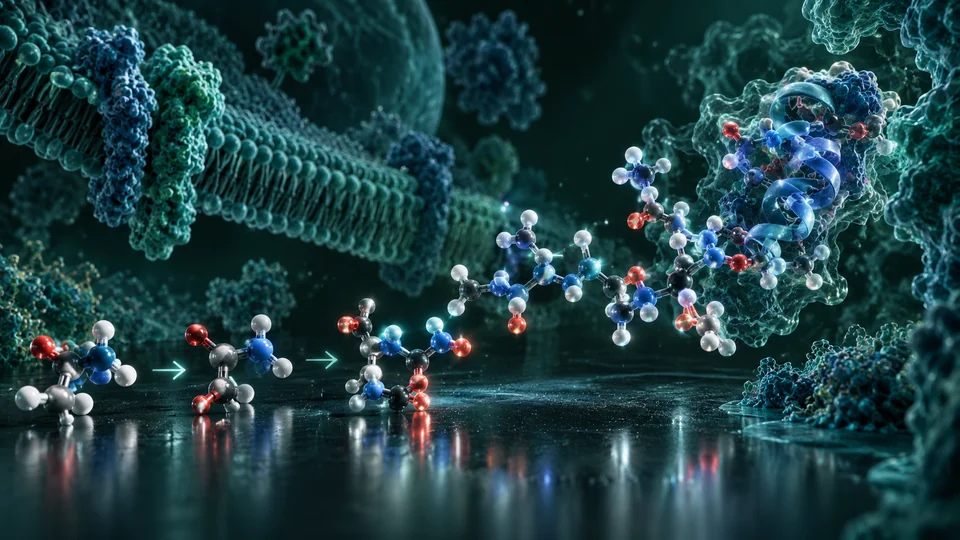
Semax grew out of research on ACTH, adrenocorticotropic hormone, which is best known for telling the adrenal glands to release cortisol. Researchers were interested in whether short fragments of ACTH might keep some effects on the nervous system without the hormonal action. Semax takes the first four amino acids of the fragment known as ACTH(4-10), Met-Glu-His-Phe, and replaces the rest with a Pro-Gly-Pro tail, giving the seven amino acid sequence Met-Glu-His-Phe-Pro-Gly-Pro Mechanistic 1. The tail was added to slow its breakdown, although the intact peptide is still cleared from rat blood within minutes In vitro 2.
Despite its origin, Semax is not a steroid and does not act as synthetic ACTH. Russian researchers describe it as a non hormonal ACTH derivative, developed for effects on the nervous system rather than on the adrenal glands 3. It is a good example of how a small change in a peptide's structure can change what it does.
Why is it given through the nose?
Semax is registered in Russia as 0.1% and 1% nasal drops 4. Nasal delivery avoids the digestive system, which would break a peptide down, and may give some access to the brain. In rats, labelled Semax reached brain tissue within minutes of nasal delivery while disappearing quickly from the blood Animal 5. That is a rat pharmacokinetic study, not a measurement in people, and a nasal spray is not harmless just because it is not an injection.
What has Semax been studied for in people?
The best known human evidence concerns ischaemic stroke. In a 1997 Russian study, 30 patients in the acute phase of stroke received Semax alongside intensive standard treatment and were compared with 80 patients treated conventionally. The authors reported faster recovery of general and focal deficits, particularly motor deficits Human 6. The comparison group was assembled separately and was nearly three times larger, and the report describes no randomisation, no placebo and no blinding.
A 2018 Russian study followed 110 patients during rehabilitation after ischaemic stroke, split into early and late rehabilitation groups and then into those who did or did not receive Semax. Semax was associated with higher plasma BDNF throughout the study and with faster and better recovery on the Barthel index, a measure of everyday independence Human 7. The abstract does not describe how patients were allocated or whether anyone was blinded.
Smaller Russian studies have tested Semax in optic nerve disease, where an open study reported better vision measures when it was added to standard treatment Human 8, and in conditions including migraine, trigeminal neuralgia and peptic ulcer 4. So Semax cannot fairly be described as having no human evidence.
Why are the stroke studies hard to interpret?
Several reasons. The studies are small, many are decades old, and most are published only in Russian language journals. They come largely from one research community and have not been repeated by independent groups elsewhere. A search of ClinicalTrials.gov finds no registered trial of Semax at all 9. When the FDA reviewed Semax for stroke related use in 2026, it set aside the Russian language stroke papers because no English translations were available, and concluded that there was insufficient evidence of effectiveness for cerebral ischaemia 4.
None of this makes the findings worthless. It means confidence should match the quality of the evidence, and for a stroke treatment the standard is a large randomised, blinded trial with patient centred outcomes. Semax has never had one.
What is BDNF and why is Semax linked with it?
BDNF, brain derived neurotrophic factor, is a protein involved in the survival of nerve cells and in how connections between them adapt. In rats, a single dose of Semax raised BDNF expression in several brain regions Animal 10, and in the rat basal forebrain Semax bound specifically to cell membranes and raised BDNF protein, although the receptor responsible was never identified Animal In vitro 1. It also changed dopamine and serotonin activity in rodent brains Animal 11.
That is the basis for the online claim that Semax "boosts BDNF". The trouble is that a biomarker is not an outcome. The only human BDNF data come from blood in stroke patients, and blood BDNF is an uncertain guide to what happens in the brain. To show a meaningful effect on thinking, a study has to measure memory, attention, learning or another relevant outcome directly. A BDNF change can support a mechanism. It cannot stand in for those outcomes.
Does Semax improve memory in healthy people?
This is where the online story runs furthest ahead of the evidence. The healthy volunteer studies are small and measure brain activity rather than performance. In a 2018 study, 24 healthy adults underwent resting state brain scans before and after a single dose of nasal Semax (14 people) or placebo (10 people). The Semax group showed a larger volume in part of the default mode network, a set of brain regions active at rest Human 12. A 2020 study of 52 healthy people compared Semax, Selank and placebo and found differences in connectivity between the amygdala and part of the temporal lobe Human 13.
These are interesting signals, but a change on a brain scan is not an IQ test, not proof of better memory and not evidence of better performance in daily life. No published controlled trial has tested whether Semax improves memory or focus in healthy adults.
What about animal neuroprotection?
The animal literature is much broader. In rats with an experimentally induced stroke in the prefrontal cortex, nasal Semax reduced the volume of damaged tissue and improved performance on a memory task learned before the injury Animal 14. Gene expression studies after experimental stroke in rats found that Semax shifted immune and blood vessel related genes Animal 15, and suppressed inflammation related genes while activating genes linked to nerve signalling Animal 16.
These findings explain why Semax was developed for neurological conditions. Animal neuroprotection is still not proof of cognitive enhancement in people.
Is Semax approved?
Semax is registered as a medicine in Russia. It is not approved in the UK, the US or the European Union, and there is no monograph for it in the European, Japanese or International pharmacopoeias 4. Approval in one country does not mean regulators elsewhere have reviewed the evidence and reached the same view, and different systems apply different standards to different indications. BioRx therefore gives regulatory status country by country rather than using the word "approved" without context.
In the UK, government guidance on importing food supplements states that the MHRA considers Semax a medicine rather than a food, and that it may only be sold or supplied in the UK if a marketing authorisation has been granted 17. None has been, so supplying it for human use falls outside the Human Medicines Regulations 2012.
In the US, the FDA's advisory committee on compounding discussed Semax on 24 July 2026 for cerebral ischaemia, migraine and trigeminal neuralgia. The FDA's briefing noted that neither Semax nor Semax acetate is a component of an FDA approved drug, found insufficient evidence of effectiveness for any of those uses, and proposed not adding Semax to the list of substances pharmacies may compound 4. The committee voted to recommend it anyway, but its votes are advisory and do not bind the FDA 18. A committee discussion about compounding is not drug approval.
Is Semax safe?
There is a history of human use, so this is not the same situation as peptides that have never been given to people. The FDA's review of the literature it could assess found Semax given by nose to roughly 33 to 47 healthy adults, 69 adults with medical conditions and 451 children, mostly without adverse events being reported or discussed. It found one direct report to its adverse event database: a consumer who described lasting eye pain and burning, and hospital treatment, after using Semax nasal drops bought online Human 4. A single report cannot show that Semax caused the problem, but it is a reminder that grey market products are unregulated.
The FDA also states that compounded Semax may carry a risk of immune reactions for some routes because of aggregation and peptide related impurities, and that it has no, or limited, safety information for the proposed routes 19. The Russian pharmaceutical product and a nasal spray labelled Semax from an online seller are not automatically the same thing. Identity, purity and formulation all matter. Products sold as N-acetyl semax amidate are a different molecule again, and a search of the research literature finds no published study of that compound in any species.
Is Semax banned in sport?
Semax is not named on the World Anti-Doping Agency's 2026 Prohibited List. Whether it falls under a general class is not settled by the text. The S0 class covers substances with no approval from any government health authority, and Semax is registered in Russia; the S2.2.2 class covers corticotrophins, and Semax is derived from ACTH but is described as lacking its hormonal action 20. Athletes subject to testing should check with their national anti doping organisation before assuming it is permitted.
Semax
Limited evidenceNeuroactive · 8 cited studies
Human data exist but consist of small, non randomised, Russian language stroke and ophthalmology studies from a single research tradition, never independently replicated and never registered, with no controlled trial at all in the healthy user population that drives its sale.
UK status. No UK marketing authorisation from the MHRA.
Semax + Selank (nootropic / anxiolytic stack)
The most used brain peptide pairing has no combination study whatsoever. The research on each one sits almost entirely in Russian language journals, unregistered and rarely repeated elsewhere.
Combination evidence. Tier 0: no combination data; single agent literature is largely unreplicated outside its country of origin
The BioRx conclusion
Semax is more scientifically developed than most substances sold online as brain peptides. It has a defined structure, a long record of use in Russia, and a body of human research in which small stroke and rehabilitation studies reported favourable neurological changes. It also has a broad animal literature on neuroprotection and BDNF.
That does not validate the modern nootropic claims. The human studies are small, mostly Russian language, unregistered, and not randomised or blinded to current standards, and none tests cognitive enhancement in healthy people. Regulators outside Russia have not accepted Semax as a medicine. The fairest summary is that Semax has genuine neurological research behind it, but its reputation as a proven nootropic goes beyond what the human evidence can support.
Frequently asked questions
Is Semax approved anywhere?
It is registered as a medicine in Russia, where it is sold as nasal drops. It has no marketing authorisation in the UK, the US or the European Union, and the MHRA treats it as a medicine that cannot be sold in the UK without one.
Does Semax raise BDNF in humans?
One Russian study in stroke patients reported higher BDNF in the blood of those given Semax. The stronger BDNF findings come from rat brains. No study has measured BDNF in the human brain after Semax, and blood levels are an uncertain guide to what happens there.
Is there evidence that Semax improves focus or memory in healthy people?
Not from controlled trials measuring performance. Small studies in healthy volunteers have reported changes on brain scans after a single dose, which is a different thing from better memory or concentration.
Is Semax the same as N-acetyl semax?
No. N-acetyl semax amidate is a chemically modified version sold online. It has no published research of its own, so nothing known about Semax can be assumed to apply to it.
Is Semax legal in the UK?
It is not a licensed medicine in the UK. Government guidance says the MHRA considers it a medicine, so it cannot lawfully be sold or supplied for human use without a marketing authorisation under the Human Medicines Regulations 2012.
References
Studies marked "View study in BioRx" sit in the clinical studies index with their design and evidence grade.
- Dolotov OV et al. (2006). Semax, an analogue of adrenocorticotropin (4-10), binds specifically and increases levels of brain-derived neurotrophic factor protein in rat basal forebrain. Journal of Neurochemistry.PubMed · DOI · View study in BioRx
- Potaman VN et al. (1991). N-terminal degradation of ACTH(4-10) and its synthetic analog semax by the rat blood enzymes. Biochemical and Biophysical Research Communications.PubMed · DOI · View study in BioRx
- Genes associated with action of ACTH-like peptides with neuroprotective potential in rat brain, Int J Mol Sci 2025
- FDA, Pharmacy Compounding Advisory Committee briefing on Semax, July 2026
- Shevchenko KV et al. (2006). Kinetics of Semax penetration into the brain and blood of rats after its intranasal administration. Bioorganicheskaia Khimiia (Russian Journal of Bioorganic Chemistry).PubMed · DOI · View study in BioRx
- Gusev EI, Skvortsova VI, Miasoedov NF, Nezavibat'ko VN, Zhuravleva EIu, Vanichkin AV (1997). Effectiveness of semax in acute period of hemispheric ischemic stroke (a clinical and electrophysiological study). Zhurnal Nevrologii i Psikhiatrii imeni S.S. Korsakova.PubMed · View study in BioRx
- Gusev EI et al. The efficacy of semax in the treatment of patients at different stages of ischemic stroke, Zh Nevrol Psikhiatr Im S S Korsakova 2018
- Polunin GS, Nurieva SM, Baiandin DL, Sheremet NL, Andreeva LA (2000). Evaluation of therapeutic effect of new Russian drug semax in optic nerve disease. Vestnik Oftalmologii.PubMed · View study in BioRx
- ClinicalTrials.gov search for Semax
- Dolotov OV et al. (2003). The heptapeptide SEMAX stimulates BDNF expression in different areas of the rat brain in vivo. Doklady Biological Sciences.PubMed · DOI · View study in BioRx
- Eremin KO et al. (2005). Semax, an ACTH(4-10) analogue with nootropic properties, activates dopaminergic and serotoninergic brain systems in rodents. Neurochemical Research.PubMed · DOI · View study in BioRx
- Effects of Semax on the Default Mode Network of the Brain, Bull Exp Biol Med 2018
- Functional Connectomic Approach to Studying Selank and Semax Effects, Dokl Biol Sci 2020
- Neuroprotective and antiamnesic effects of Semax during experimental ischemic infarction of the cerebral cortex, Bull Exp Biol Med 2006
- Medvedeva EV et al. (2014). The peptide semax affects the expression of genes related to the immune and vascular systems in rat brain focal ischemia: genome-wide transcriptional analysis. BMC Genomics.PubMed · DOI · View study in BioRx
- Novel Insights into the Protective Properties of ACTH(4-7)PGP (Semax) at the Transcriptome Level Following Cerebral Ischaemia-Reperfusion in Rats, Genes 2020
- GOV.UK, Importing food supplements and health foods
- NCPA, FDA advisory committee nominates six peptides for pharmacies to compound, July 2026
- FDA, Certain bulk drug substances for use in compounding that may present significant safety risks
- WADA, 2026 Prohibited List