Mechano growth factor sounds like a synthetic performance drug, but it is actually a natural biological signal. When skeletal muscle is placed under heavy mechanical load or damaged, it expresses a specific variant of the insulin like growth factor 1 gene. This local variant is responsible for activating the muscle stem cells that begin the tissue repair process. 1
In fitness and performance communities, synthetic versions of this molecule are frequently discussed as recovery aids. Discussions often confuse the body's natural response to exercise with the synthetic laboratory peptides. While the underlying biology of the natural gene is well documented, the synthetic peptides lack human clinical trials and are not approved medicines. 2
The discovery of the local repair signal
The identification of mechano growth factor emerged from research into how skeletal muscle adapts to exercise. Scientists observed that muscle tissue could produce its own local growth factors independently of the liver, which is the primary source of circulating IGF-1. 1
The IGF-1 gene is a complex sequence of DNA that serves as the blueprint for several different growth factors. Through a process called alternative splicing involving exons 4, 5, and 6, the cellular machinery can produce distinct messenger RNA transcripts. The primary systemic version of IGF-1 is produced mainly in the liver under the control of growth hormone. 2
When skeletal muscle is subjected to mechanical stretch or physical damage, the local cellular machinery alters its splicing pattern. This results in a reading frame shift during the IGF-1 gene splicing to produce a distinct mature isoform. The result is a protein that shares the main IGF-1 structure but ends with a completely different tail sequence. 3
This unique tail is the 24 amino acid E domain. Because its expression is highly sensitive to mechanical loading, researchers named this specific splice variant mechano growth factor. In human biology, the transcript is formally designated as IGF-1Ec, which has a 49 base pair insert. In rodent models, the equivalent mechano responsive variant is called IGF-1Eb, which has a 52 base pair insert. This difference in nomenclature often causes confusion when reading the primary literature, but the biological function of the mechano responsive E domain remains consistent across species. 2 3
A distinct receptor mechanism
The discovery that the E domain has its own biological activity was an important finding in muscle biology. For decades, researchers believed that all IGF-1 variants worked by binding to the standard IGF-1 receptor. The E domain of mechano growth factor operates differently. 4
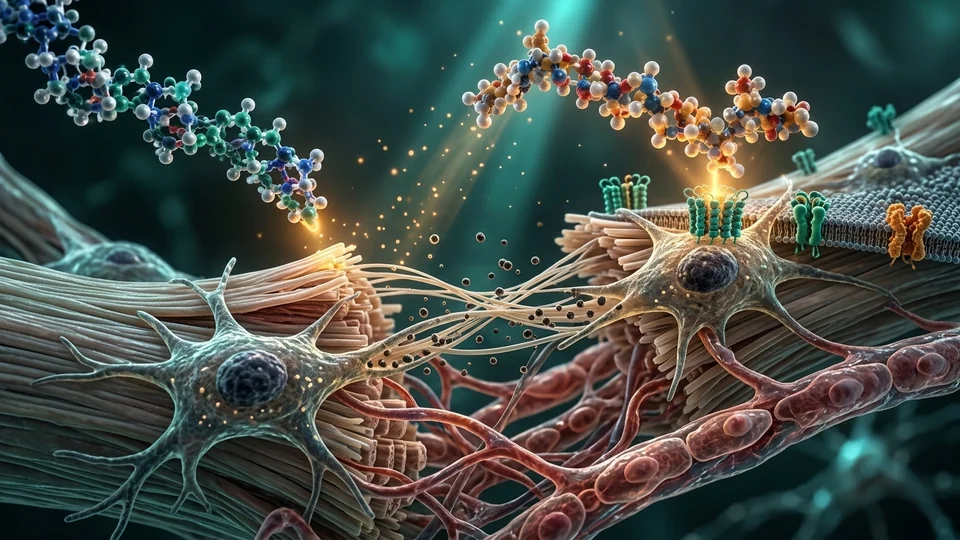
In an early in vitro study using myoblast cells, researchers compared the effects of the isolated E peptide against mature IGF-1. They found that the E domain significantly increased cell proliferation while actively preventing the cells from differentiating into mature muscle fibres too early. To prove that this was a separate mechanism, the researchers used specific antibodies to block the standard IGF-1 receptor. Even with the primary receptor disabled, the E peptide continued to stimulate cell division. This demonstrated that the E domain operates through an independent receptor pathway that is specific to the activation of muscle stem cells. 4
How the natural signal controls muscle repair
Skeletal muscle is a post mitotic tissue, meaning its mature cells cannot divide to replace damaged sections. Repair and growth depend entirely on satellite cells. These are specialised stem cells that lie dormant on the surface of muscle fibres. When a muscle is injured or heavily loaded, these cells must wake up, multiply and fuse with the damaged fibres to provide new nuclei for protein synthesis. 1
Animal studies demonstrate how this works in living tissue. In one experiment, researchers induced local muscle damage in the anterior tibialis muscle of rats using stretch combined with electrical stimulation, as well as injection of bupivacaine. They tracked the expression of different IGF-1 variants over time. The expression of mechano growth factor peaked rapidly following the damage, preceding the appearance of M-cadherin, a marker for satellite cell activation. The systemic IGF-1Ea variant peaked much later. 1
This sequential expression suggests a division of labour. The initial pulse of mechano growth factor expands the pool of stem cells, and the later arrival of standard IGF-1 directs those cells to maintain protein synthesis and complete the repair. 1
The synthetic MGF peptide
While the natural IGF-IEb mRNA is upregulated after injury to promote remodeling, no analogous peptide product of the IGF-1 gene has actually been identified in or isolated from cultured cells, animal tissues, or biological fluids. To study its effects, researchers use a synthetically manufactured peptide corresponding to the 24 most C-terminal residues of the IGF-IEb variant. This synthetic MGF has been shown to promote cellular proliferation and survival in laboratory settings. 2
What does the human evidence actually show?
Despite its popularity in fitness circles, the human evidence for synthetic mechano growth factor is strictly limited to isolated cells and observational data. 3
When researchers tested the synthetic E peptide on human tissue, they observed this age dependent effect directly. In an in vitro study, primary human muscle progenitor cells were isolated from healthy donors of different ages. The synthetic peptide significantly increased the proliferative lifespan and delayed the cellular ageing of satellite cells taken from neonatal and young adult donors. However, it failed to produce the same activation in cells taken from older adults. 3
This cell culture data represents the extent of the human evidence. There are no published, placebo controlled human clinical trials evaluating synthetic MGF for muscle hypertrophy, injury recovery or age related muscle wasting. The compound has never been tested for safety, pharmacokinetics or efficacy in a living human subject. Any claims regarding its exact effects, optimal dosing or safety profile in humans are extrapolated entirely from rodent models and cell biology. 2
UK regulatory status and sport rules
MGF is not an approved medicine in the United Kingdom.
In the UK, the regulation of medicinal products is strict and clearly defined. Any substance that is manufactured, sold or supplied with claims of treating, preventing or altering a physiological condition, including tissue repair or muscle regeneration, falls under the jurisdiction of the MHRA. 5
Under the Human Medicines Regulations 2012, regulation 46, a medicinal product needs a marketing authorisation to be sold or supplied. No such authorisation exists for MGF. It has not been evaluated for safety, quality or efficacy by any regulatory body. Companies wishing to develop these peptides into legitimate therapeutics must conduct extensive human trials and apply for a licence to market a medicine in the UK. Until then, they remain unapproved experimental compounds. 6 7
For competitive athletes, the regulations are equally absolute. The World Anti-Doping Agency prohibits the use of these compounds at all times, both in and out of competition. They are explicitly listed under the section covering growth factors and growth factor modulators. Athletes subject to testing face severe sanctions for the use of synthetic mechano growth factor. 8
Mechano growth factor (IGF-1Ec E-peptide)
Preclinical onlyGrowth factors · 7 cited studies
All administration data are cell culture and animal; the human facing literature is confined to observation of endogenous IGF-1Ec transcript expression and to anti doping analytical characterisation, and no registered trial has ever administered MGF peptide to people.
UK status. No MHRA marketing authorisation and no clinical trial authorisation.
- Metabolic & incretin 27
- GH secretagogues 8
- Growth factors 7
- Tissue repair 8
- Immune modulation 7
- Antimicrobial & antibiotic 5
- Neuroactive 24
- Melanocortin 9
- Reproductive & GnRH 11
- Endocrine & pituitary 17
- Cardiovascular & haemostasis 10
- Gastrointestinal 12
- Oncology & diagnostic 11
- Longevity & mitochondrial 21
- Cosmetic & dermatological 19
The BioRx conclusion
Mechano growth factor is a complex piece of human biology. The discovery that a single gene can be spliced differently to produce both a systemic growth signal and a local repair trigger helped explain how muscle adapts to mechanical stress. 1
The biological importance of the natural gene does not automatically validate the synthetic peptide. The laboratory evidence shows that the E domain can activate muscle stem cells in vitro and in animal models. Without human clinical trials, the safety, effective dosing and actual clinical outcomes of synthetic MGF remain unknown. It remains a research tool rather than a proven therapeutic. 2
Frequently asked questions
What is mechano growth factor?
Mechano growth factor is a natural splice variant of the insulin like growth factor 1 gene. It is produced locally in skeletal muscle in response to mechanical loading or tissue damage, where it acts to activate muscle stem cells for repair. 1
What is the difference between IGF-1 and MGF?
Standard IGF-1 is produced mainly by the liver. MGF is a specific local variant produced in muscle tissue. It contains a unique E peptide sequence that allows it to stimulate cell proliferation through a different receptor pathway than mature IGF-1. 4
Is MGF approved for human use?
No. MGF is not approved by the MHRA for human use. There are no published human clinical trials evaluating it as a medicine, and it remains an experimental laboratory compound. 7
Is MGF banned in sport?
Yes. MGF and its analogues are prohibited at all times by the World Anti-Doping Agency. They are classified under the growth factors section of the prohibited list. 8
References
Studies marked "View study in BioRx" sit in the clinical studies index with their design and evidence grade.
- PubMed, PMID 12892408
- Matheny RW Jr et al. (2010). Minireview: Mechano-growth factor: a putative product of IGF-I gene expression involved in tissue repair and regeneration. Endocrinology.PubMed · DOI · View study in BioRx
- Kandalla PK et al. (2011). Mechano Growth Factor E peptide (MGF-E), derived from an isoform of IGF-1, activates human muscle progenitor cells and induces an increase in their fusion potential at different ages. Mechanisms of Ageing and Development.PubMed · DOI · View study in BioRx
- PubMed, PMID 12095637
- MHRA, the Medicines and Healthcare products Regulatory Agency
- Human Medicines Regulations 2012, regulation 46: a medicinal product needs a marketing authorisation to be sold or supplied
- MHRA guidance: apply for a licence to market a medicine in the UK
- WADA Prohibited List 2026