Comparing BPC-157 vs TB-500 can feel like comparing two recovery tools designed for slightly different jobs. It is an understandable impression, but before asking which is better for an injury there are more basic questions. Are the compounds clearly identified? What has actually been tested? And did those experiments show that people recovered, rather than that cells behaved differently? Asked of these two peptides, those questions reveal a much less settled picture than a comparison chart suggests.
What is BPC-157?
BPC-157 is a synthetic peptide of 15 amino acids. Most of the research relevant to injury comes from laboratory and animal experiments. In one 2010 study, rats with a surgically cut knee ligament healed better on BPC-157, with improvements in function, mechanical strength and the tissue itself Animal 1.
That makes BPC-157 scientifically interesting, but it is still a controlled animal injury. An injured person is asking a different question: will this help my particular injury, and what are the risks? A positive animal study is a reason to investigate that question, not the answer to it. BPC-157: what does the human evidence show? covers the compound in depth.
What is TB-500?
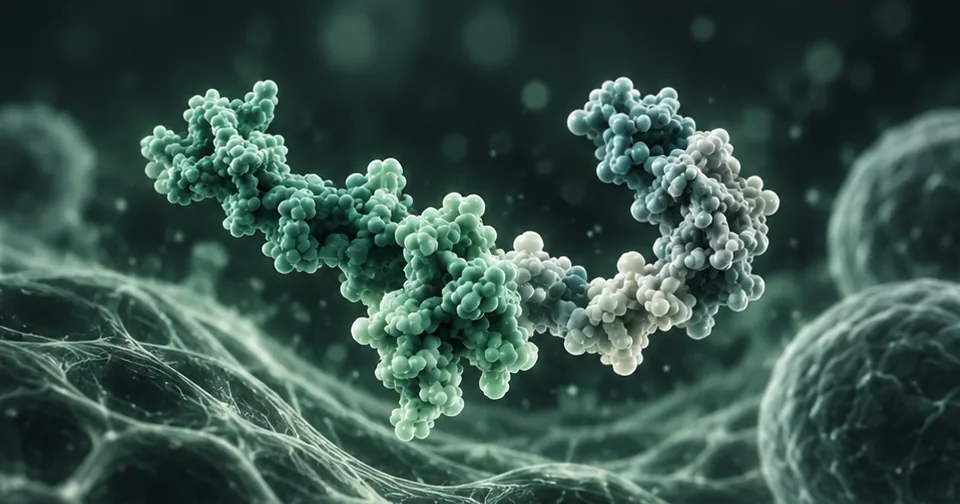
The name needs more care. Thymosin beta-4 is a natural peptide of 43 amino acids. A product analysed in 2012 as TB-500 contained an acetylated seven amino acid segment of that larger molecule 2. Because the terminology is used loosely, a reference to "TB-500 research" can lead to a paper that studied something else.
The safest approach is to keep full length thymosin beta-4 separate from the shorter TB-500 fragment unless the exact substance is known. That can sound like a technical detail. It is actually where an honest comparison starts, because two substances cannot be compared reliably when one name changes meaning halfway through. TB-500 explained goes through the distinction.
BPC-157 vs TB-500 at a glance
| Question | BPC-157 | TB-500 |
|---|---|---|
| What is being discussed? | A synthetic peptide of 15 amino acids. | A name linked to a thymosin beta-4 fragment, but sometimes used loosely. |
| Where does the repair interest come from? | Cell and animal injury research. | Research on thymosin beta-4 and its fragments, which must be kept apart. |
| Proven faster recovery from human sports injury? | Not established. | Not established for the fragment. |
| Can one be called better for tendons or muscles? | Not from the clinical evidence. | Not from the clinical evidence. |
| Does combining them close the evidence gap? | No. A combination needs its own evidence. | No. A combination needs its own evidence. |
The identity point rests on analytical work. The clinical caution reflects how little human evidence exists, and the FDA's own assessments of both substances.
| Compound | Mechanism | Half life | UK status | Evidence |
|---|---|---|---|---|
| BPC-157 | BPC-157 has no identified receptor. | Reported as under 30 minutes, with hepatic metabolism and renal clearance, in the preclinical literature summarised by the 2025 HSS Journal systematic review. | No MHRA marketing authorisation. | Preclinical only |
| TB-500 (thymosin beta-4) | Thymosin beta-4 is the major G-actin sequestering protein in mammalian cells. | Not established. | No MHRA marketing authorisation for any thymosin beta-4 product. | Mixed evidence |
Do they work through different mechanisms?
Researchers have linked BPC-157 to several repair related processes rather than one clearly proven healing receptor; in fact no receptor for it has been identified. One laboratory study looked at tendon cells growing out, surviving and migrating, which matters because repair involves cells moving, surviving and organising new material, not simply making more tissue In vitro Animal 3.
Full length thymosin beta-4 has its own repair research. In a 1999 animal study it improved skin wound healing in rats, including faster wound closure and more collagen and new blood vessels Animal 4. That is evidence about full length thymosin beta-4 in one wound model, not about a TB-500 product healing human tendons.
Different mechanisms make a comparison interesting. They cannot tell you which treatment would be useful. Two tools can work differently without either being right for the job.
Is BPC-157 "local" and TB-500 "systemic"?
Treat that neat division with caution. To back it up clinically, researchers would need to identify each compound, measure where it goes in the body, establish the exposure that matters and connect that exposure to real outcomes. Where a substance is given does not prove where it acts, and an effect in one tissue does not prove a whole body healing benefit.
The practical problem with local versus systemic comparisons is that they sound like settled prescribing advice when the human evidence to support that is missing. They should not be used to decide where to inject anything or which experimental compound to choose for an injury.
Have they been used together in human research?
There is one small report worth describing accurately. A 2021 retrospective study of knee pain contacted 16 patients: twelve had received BPC-157 alone and four had received BPC-157 with thymosin beta-4 Human 5. Most reported improvement, but there was no placebo group, no random allocation and no standard measure of recovery.
So it would be wrong to say there is no published human observation of the combination. It would be equally wrong to call it proof that a BPC-157 and TB-500 stack works. The report named thymosin beta-4 rather than a characterised TB-500 product, and four cases cannot show an added benefit. It is an observation that could inform further research.
Wolverine Stack (BPC-157 + TB-500)
The best documented stack here, and the documentation argues against it. A 2026 rat study tested the two peptides together and found no extra benefit over either one alone.
Combination evidence. Tier 1: animal combination data exists and was negative for additivity; no human combination data
Why a combination cannot be judged by adding mechanisms together
Suppose compound A seems to influence one repair process and compound B another. It is tempting to assume that using both gives a stronger result. But they might help independently, overlap, do nothing extra together or cause new problems. That is why combination research compares the combination with each component on its own as well as with doing nothing. For BPC-157 and a precisely identified TB-500 or thymosin beta-4 preparation, a useful trial would ask whether the pair improves a meaningful outcome beyond either alone. Calling something a stack does not answer that, and neither does describing two plausible mechanisms side by side.
Pain improvement is not tissue repair
This is one of the most important distinctions in the whole BPC-157 vs TB-500 debate. When someone says "it worked", they might mean they had less pain, could walk further, a scan changed, or they returned to sport and stayed injury free. All of those can matter, but they are not interchangeable. A treatment might ease symptoms without showing that a damaged tendon is mechanically stronger, and a change on a scan may not tell you whether someone can do the activity they care about. When the claim is "repairs tissue", the evidence needs to test tissue repair, not rely on someone feeling better. The small knee pain report did not show cartilage regrowth or the repair of a specific structural injury.
Which has more research?
That question has two parts. BPC-157 has directly relevant animal experiments on musculoskeletal injury, including ligament and tendon to bone models. Full length thymosin beta-4 has its own repair research, including human eye trials, but that work should not be relabelled as evidence for the shorter TB-500 fragment. Counting papers without checking what they studied misleads: ten cell studies do not add up to a clinical trial, and a human eye study of thymosin beta-4 does not become a tendon study because both involve repair. The better question is how much research directly tests the claim being made.
Is either one established as safe?
No. The available evidence does not give a dependable long term safety profile for either as an injury treatment. In its briefing for the July 2026 compounding advisory committee, the FDA described BPC-157 as not well characterised, found no evidence of effectiveness for the condition it was nominated for, and said clinical safety information was insufficient 6. For the TB-500 fragment it said it has not identified any human exposure data, and raised concerns about immune reactions and impurities 7.
That does not mean every possible harm has been shown. It means important questions remain unanswered. "Research has shown a particular risk" and "research has not adequately established the risks" are different statements, and both matter.
What about athletes?
Both are banned at all times under the 2026 WADA Prohibited List: BPC-157 under section S0, non approved substances, and thymosin beta-4 and its derivatives, including TB-500, under section S2.3 8. That is a separate matter from whether they work. A ban tells an athlete which rules apply, not which internet claims are true, and it is not evidence that either compound speeds recovery.
BPC-157
Preclinical onlyTissue repair · 9 cited studies
The 2025 HSS Journal systematic review screened 544 articles and included 36, of which 35 were preclinical and the single clinical item was a retrospective series of 12 patients; the widely repeated claim that BPC-157 was 'safe in clinical trials' for inflammatory bowel disease traces to assertions inside review articles, not to any published trial report.
UK status. No MHRA marketing authorisation.
TB-500 (thymosin beta-4)
Mixed evidenceTissue repair · 10 cited studies
Genuine randomised, placebo controlled Phase 2 and Phase 3 trials exist in venous ulcers, pressure ulcers, dry eye and myocardial infarction, involving well over a thousand registered participants in total, but the large ophthalmic programme has not delivered a published primary endpoint success and no regulator has approved the peptide for any indication.
UK status. No MHRA marketing authorisation for any thymosin beta-4 product.
The BioRx conclusion
There are genuine scientific differences between BPC-157, full length thymosin beta-4 and the fragment sold as TB-500. What is missing is the clinical evidence to turn those differences into a reliable choice for an injured person. BPC-157 vs TB-500 is not currently a contest with a proven winner. It is a comparison between research questions, and one of them starts with making sure the molecule has been identified correctly.
Frequently asked questions
Which is better, BPC-157 or TB-500?
Neither has been shown to speed recovery from a human injury in a controlled trial, so the evidence cannot pick one.
Is TB-500 the same as thymosin beta-4?
No. A product sold as TB-500 was found to contain a seven amino acid fragment of thymosin beta-4, which has 43 amino acids. Evidence about the full molecule does not automatically apply to the fragment.
Has the Wolverine stack been tested in people?
Not as a combination in a controlled trial. One small retrospective knee pain report included four people who received BPC-157 with thymosin beta-4, with no control group.
Are BPC-157 and TB-500 legal in the UK?
Neither has a UK marketing authorisation, and supplying either for human use is unlawful under the Human Medicines Regulations 2012. Both are banned in sport.
References
Studies marked "View study in BioRx" sit in the clinical studies index with their design and evidence grade.
- Cerovecki T et al. Pentadecapeptide BPC 157 (PL 14736) improves ligament healing in the rat. J Orthop Res 2010;28:1155-1161
- Esposito S et al. (2012). Synthesis and characterization of the N-terminal acetylated 17-23 fragment of thymosin beta 4 identified in TB-500, a product suspected to possess doping potential. Drug Testing and Analysis.PubMed · DOI · View study in BioRx
- Chang CH et al. (2011). The promoting effect of pentadecapeptide BPC 157 on tendon healing involves tendon outgrowth, cell survival, and cell migration. Journal of Applied Physiology.PubMed · DOI · View study in BioRx
- Malinda KM et al. (1999). Thymosin beta4 accelerates wound healing. Journal of Investigative Dermatology.PubMed · DOI · View study in BioRx
- Lee E, Padgett B (2021). Intra-Articular Injection of BPC 157 for Multiple Types of Knee Pain. Alternative Therapies in Health and Medicine.PubMed · View study in BioRx
- FDA, Pharmacy Compounding Advisory Committee briefing on BPC-157, July 2026
- FDA, Certain bulk drug substances for use in compounding that may present significant safety risks
- WADA, 2026 Prohibited List