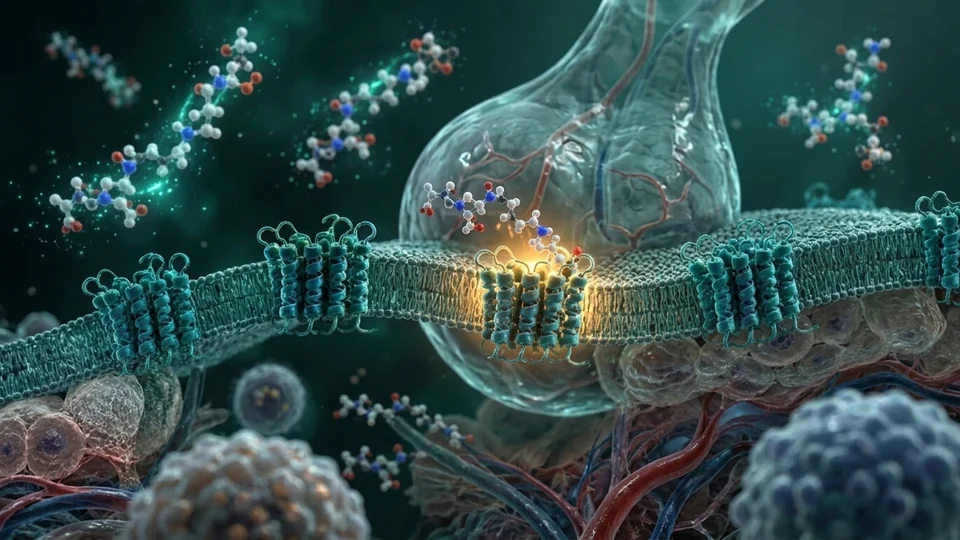
Despite sharing a parent molecule, they are not interchangeable. Their structural modifications push their pharmacokinetics in opposite directions. One was designed to persist and activate receptors systematically, while the other was truncated to act rapidly at a specific site before being cleared. Understanding the difference requires looking at how the body regulates natural growth signals and how these synthetic peptides bypass those controls.
| Compound | Mechanism | Half life | UK status | Evidence |
|---|---|---|---|---|
| LR3-IGF-1 | Native IGF-1 is not a free floating hormone. | Not established in humans. | No MHRA marketing authorisation. | Preclinical only |
| Des(1-3)IGF-1 | The N-terminal tripeptide of mature IGF-1 is Gly-Pro-Glu. | Not established in humans. | No MHRA marketing authorisation. | Preclinical only |
The growth hormone axis and the binding protein problem
In human physiology, it is the primary mediator of growth hormone's anabolic effects, stimulating cell growth, protein synthesis and tissue repair across muscle, bone and connective tissue.
IGF-1 LR3: Engineering sustained receptor exposure
Animal clearance data show the opposite. Because IGF-1 LR3 has very low affinity for binding proteins, the peptide is actually cleared from circulation more quickly than native IGF-1. Animal 1
When administered systemically in animal models, this free fraction strongly activates receptors. In rats, continuous infusion of IGF-1 LR3 was 1.5 to 2-fold more potent than native IGF-1 for increasing body weight gain, visceral organ weights and feed use efficiency. Animal 1
IGF-1 DES: Truncation for acute local signalling
In laboratory models, researchers use IGF-1 DES to study growth without binding protein interference. In growth hormone deficient mice, daily injections of IGF-1 DES for three weeks increased body length and organ weights, such as the kidney and heart, more potently than native IGF-1. Animal 2
What does the preclinical evidence show?
In vitro studies using breast carcinoma cells demonstrate that binding proteins can still interfere with these analogues through other mechanisms. Even though IGF-1 DES has weak or no affinity for binding proteins, the presence of IGFBP-3 dose dependently inhibited the receptor autophosphorylation and tyrosine kinase activity stimulated by the analogue. In vitro 3
When administered by injection, analogues that evade binding proteins demonstrate increased biological potency compared to native IGF-1. In rats, injected IGF-1 LR3 retained superior potency to injected native IGF-1 for several actions, though the potency was reduced compared with continuous infusion. Animal 1
This increased potency comes entirely from preclinical data. There are no published human clinical trials confirming efficacy, safety or long term effects for either compound in a performance, recovery or anti aging context. The metabolic and cellular consequences of bypassing the body's natural binding protein regulation in humans remain unknown.
The theoretical risks of unbound growth factors
The binding proteins exist for a reason: they act as a safety buffer.
Finally, IGF-1 is a powerful survival factor for many cell types, meaning it inhibits apoptosis, the programmed cell death that clears damaged or mutated cells. Bypassing the binding proteins removes the body's ability to switch off this survival signal. In the context of abnormal cell proliferation, an unregulated survival signal is a significant concern, which is why researchers use breast carcinoma cells to study how binding proteins modulate the signalling pathways of these analogues. In vitro 3
UK regulatory and anti doping status
The Medicines and Healthcare products Regulatory Agency (MHRA) regulates medicines in the UK. 4
Under the Human Medicines Regulations 2012, a medicinal product requires a marketing authorisation before it can be legally sold or supplied for human use. 5
In competitive sport, both analogues are strictly prohibited. The World Anti-Doping Agency (WADA) lists them under section S2 (Peptide Hormones, Growth Factors, Related Substances, and Mimetics). Because they are growth factor analogues that alter muscle and tissue physiology, they are banned at all times, both in and out of competition. 6
LR3-IGF-1
Preclinical onlyGrowth factors · 6 cited studies
Every surviving citation is in vitro, rodent or livestock work plus one analytical characterisation of a seized vial; there is no registered interventional clinical trial and no published human administration study.
UK status. No MHRA marketing authorisation.
Des(1-3)IGF-1
Preclinical onlyGrowth factors · 6 cited studies
Every surviving citation is rodent, mouse or in vitro work, or a narrative review of that work; no registered human trial or published human administration study of des(1-3)IGF-1 exists.
UK status. No MHRA marketing authorisation.
The BioRx conclusion
This makes them highly effective tools for laboratory research, allowing scientists to study receptor activation without interference. However, this evasion of natural biological controls is exactly what makes their use outside of a laboratory highly unpredictable. With no human clinical trials, their safety profile and long term consequences remain completely unmapped.
- Metabolic & incretin 27
- GH secretagogues 8
- Growth factors 7
- Tissue repair 8
- Immune modulation 7
- Antimicrobial & antibiotic 5
- Neuroactive 24
- Melanocortin 9
- Reproductive & GnRH 11
- Endocrine & pituitary 17
- Cardiovascular & haemostasis 10
- Gastrointestinal 12
- Oncology & diagnostic 11
- Longevity & mitochondrial 21
- Cosmetic & dermatological 19
Frequently asked questions
What is the main difference between IGF-1 LR3 and IGF-1 DES?
IGF-1 LR3 is designed for prolonged systemic receptor activation, whereas IGF-1 DES is a truncated analogue designed for rapid, highly localised activity. Both evade binding proteins, but their clearance rates and intended research applications differ significantly.
Why do these analogues evade binding proteins?
Native IGF-1 is tightly regulated by binding proteins that prevent it from interacting with receptors. By altering the molecular structure, whether by adding an extension in LR3 or removing amino acids in DES, researchers created analogues that cannot fit into these binding proteins, leaving the entire dose free to act.
Does IGF-1 LR3 really have a 30 hour half life?
No. Animal pharmacokinetic data show that because LR3 evades binding proteins, it cannot form the large protective complex that extends the life of native IGF-1. It is cleared faster than bound native IGF-1.
Are IGF-1 LR3 and IGF-1 DES approved for human use?
No. Neither compound is approved for human use. They are strictly experimental research chemicals with no human clinical trial data supporting their safety or efficacy.
Are these peptides banned in sport?
Yes. Both analogues are listed on the WADA Prohibited List under section S2 and are banned at all times in competitive sport.
References
Studies marked "View study in BioRx" sit in the clinical studies index with their design and evidence grade.
- PubMed, PMID 8708565
- Gillespie C et al. (1990). Enhanced potency of truncated insulin-like growth factor-I (des(1-3)IGF-I) relative to IGF-I in lit/lit mice. Journal of Endocrinology.PubMed · DOI · View study in BioRx
- PubMed, PMID 11145572
- MHRA, the Medicines and Healthcare products Regulatory Agency
- Human Medicines Regulations 2012, regulation 46: a medicinal product needs a marketing authorisation to be sold or supplied
- WADA Prohibited List