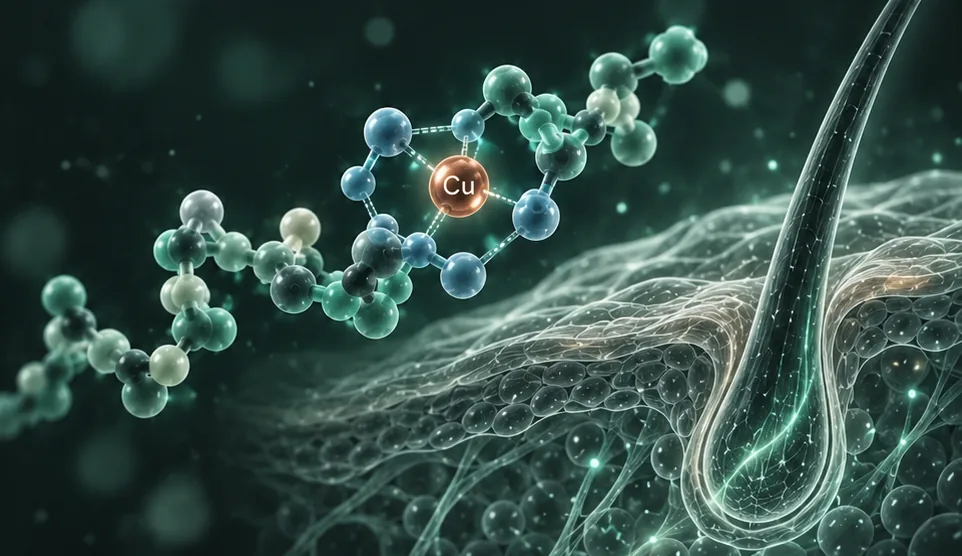
GHK-Cu has become one of the most talked about peptides in skincare, and it is now promoted for hair growth too. Search for GHK-Cu hair growth and you will find claims that copper peptides wake up dormant follicles, increase blood flow, lengthen the growth phase and rival established hair loss treatments. There is some genuine science behind the interest. There is also one important problem: the hair study quoted most often in support of copper peptides did not study GHK-Cu. It studied a related copper peptide called AHK-Cu, and that single detail changes how the rest of the evidence should be read. This article looks at hair specifically; for skin, wound healing and the wider GHK-Cu story, see GHK-Cu and copper peptides.
What is GHK-Cu?
GHK-Cu is a small peptide of three amino acids, glycine, histidine and lysine, bound to a copper ion. The bare peptide occurs naturally in human plasma, and its ability to hold copper is what makes it biologically interesting. It has been studied in tissue repair and skin biology for decades, with laboratory work linking it to fibroblast activity, collagen production and the constant rebuilding of the material that holds skin together In vitro 1. Those findings explain its place in cosmetic products.
Hair follicles are small, complex organs set in the skin, so it is reasonable to ask whether the same biology could affect hair. Asking the question is not the same as answering it, though, and most of what is written online skips from the first to the second.
How does hair actually grow?
Each hair follicle cycles through phases. The main growth phase is called anagen; the follicle then leaves active growth, rests, and eventually sheds the hair before starting again. In androgenetic alopecia, the common inherited form of male and female pattern hair loss, affected follicles gradually shrink over successive cycles and produce thinner, shorter hairs. This shrinking is called miniaturisation.
A cluster of specialised cells at the base of the follicle, the dermal papilla, helps control the cycle and signals to the cells around it. That makes dermal papilla cells an obvious target in hair research, and it is exactly where the copper peptide story begins.
What did the famous copper peptide hair study test?
A 2007 laboratory study examined a copper complex of alanine, histidine and lysine, known as AHK-Cu In vitro 2. The researchers kept human hair follicles alive outside the body and grew dermal papilla cells in culture. AHK-Cu lengthened the follicles and increased dermal papilla cell growth, and at one concentration it shifted markers of programmed cell death in a protective direction, although the fall in the number of dying cells did not reach statistical significance.
Those are interesting findings with two limits that matter. First, AHK-Cu is not GHK-Cu. GHK begins with glycine and AHK begins with alanine, and peptides are defined by their sequence: changing one amino acid can change shape, stability and biological behaviour. Similar peptide does not mean similar effect. Second, the work was done in a dish. Follicles and cells studied outside a living person tell you nothing yet about whether a product applied to the scalp reaches them, in what amount, or with what result. The study supports the idea that copper binding tripeptides deserve investigation in hair biology. It does not show that GHK-Cu regrows hair, and the citation should stay attached to the molecule that was actually tested.
Where do the GHK-Cu hair claims come from?
Much of the literature that links GHK-Cu itself to hair was written by Loren Pickart, who isolated GHK in 1973 and later commercialised copper peptides. His reviews list hair follicles among the tissues GHK helps repair and describe an increase in hair follicle size Mechanistic 3 1. Reviews are only as strong as the studies beneath them, and for hair those studies are animal work. A 1991 paper, with Pickart among its authors, reported hair follicle stimulating effects of peptide copper complexes in mice Animal 4. A 1993 review of hair growth agents described a copper binding peptide, coded PC1031, enlarging follicles on the backs of fuzzy rats, with an effect similar to topical minoxidil in that model Animal 5. The abstract does not say whether PC1031 was GHK-Cu or a modified version of it.
So there is a biological rationale, drawn from rodents and from follicles in culture, and a body of review writing largely by the peptide's developer. That is different from saying there is no evidence. It is also a long way from a controlled trial in people losing their hair, and we could not find a published randomised trial of GHK-Cu on its own for any form of hair loss.
What about the 2025 minoxidil, dutasteride and copper peptide study?
This is the newest human report, and it is often shared as proof that copper peptides work. In 2025 a group led by dermatologists at Brown University described seven men with pattern hair loss who had not responded well to at least a year of standard treatment Human 6. Over five monthly sessions a tattoo machine was used to deliver a solution of minoxidil, dutasteride and copper peptides into the scalp, and the men carried on using topical minoxidil at home.
Four dermatologists rated blinded photographs taken before and after treatment. The median share of the top of the scalp judged bald fell from 40% to 7.5%, and five of the seven men gained more than 10% coverage. No scarring or infection was reported.
The result sounds far more clinical than a follicle in a dish, but it cannot answer the question people ask of it. Three active ingredients were given together, and two of them already have established effects on hair: minoxidil stimulates growth and dutasteride blocks the enzyme that makes dihydrotestosterone (DHT). With no group that received the same treatment without copper peptides, nobody can say how much of the improvement, if any, came from the copper. That is confounding. The authors themselves list the lack of a control arm and of objective measures such as hair counts as limitations. The paper does not name which copper peptide was used, and the reference it gives for copper peptides stimulating follicles is the 2007 AHK-Cu study. It was also a retrospective look back at seven patients rather than a planned trial. The authors compared their results with an earlier series of three sessions without copper peptides, but the newer protocol also used more sessions and deeper needles, so the copper peptide cannot be credited with the difference.
Does GHK-Cu block DHT?
This claim appears often online, and the evidence for it is much weaker than the wording suggests. DHT drives follicle miniaturisation in genetically susceptible people. Finasteride and dutasteride reduce DHT by blocking 5 alpha reductase, the enzyme that makes it, and that effect has been measured in people. GHK-Cu has no comparable body of human evidence showing it lowers DHT in the scalp or the blood. It may influence parts of follicle biology, inflammation, blood vessel signalling or tissue remodelling, but none of that amounts to demonstrated DHT suppression in people with pattern hair loss. Mechanistic speculation should not be presented as a treatment effect.
Could GHK-Cu make existing follicles healthier?
Possibly, and that is a more cautious way to frame the idea. Copper peptides have shown effects on cells associated with skin and hair follicles in the laboratory, which could in theory influence the environment a follicle grows in. Even if a substance improves some cellular conditions, though, it does not follow that it reverses miniaturisation in a living scalp. The size of any effect matters, and so do the formulation, how the peptide is delivered and what is causing the hair loss in the first place.
Hair loss is not one condition
Hair loss from iron deficiency is a different problem from androgenetic alopecia. Alopecia areata involves different biology again, and shedding after illness or stress behaves differently from inherited thinning. The NHS lists causes including inherited pattern hair loss, illness, stress, cancer treatment, weight loss and iron deficiency 7. That is why "GHK-Cu for hair loss" is too broad to be useful. A credible study has to say which condition it treated, and a result in one kind of hair loss cannot be carried over to another.
What about GHK-Cu scalp serums?
Topical GHK-Cu products are widely sold, but whether a finished product works depends on more than the name on the ingredient list. Concentration matters, stability matters, the rest of the formula matters, and so does whether the peptide reaches the relevant parts of the follicle. GHK-Cu is charged and water loving, and skin penetration studies find that most of it stays in the outer layer of skin rather than reaching the living tissue beneath In vitro 8. A study in which cells are bathed directly in a peptide does not show that a scalp serum delivers the same exposure. The evidence that would settle it is a randomised trial of the actual finished product in a defined type of hair loss, and that evidence has not been published.
What about injectable GHK-Cu for hair?
This is a separate question. Research on cosmetic ingredients applied to the skin does not establish that injecting them is safe. The US FDA has said that compounded injectable GHK-Cu may carry a risk of immune reactions because of clumping of the peptide and peptide related impurities 9. GHK-Cu now sits in that page's list of nominations that were withdrawn, which is a procedural step rather than a finding of safety. The concern is about injection and says nothing about ordinary cosmetic use; the route matters, because a serum on the skin and an injected preparation are very different exposures.
How does GHK-Cu compare with established hair loss treatments?
For androgenetic alopecia, established treatments have been tested in controlled human trials. In one randomised, double blind trial, 393 men with pattern hair loss used a 5% or 2% topical minoxidil solution or an inactive solution for 48 weeks Human 10. The 5% solution beat both the weaker strength and the inactive solution on hair counts in a marked area of scalp, and on both the men's and the investigators' ratings of scalp coverage. It also caused more itching and local irritation.
That is a different level of evidence from a follicle studied in a laboratory. It does not mean every established treatment works for everyone; it shows what stronger evidence looks like, and GHK-Cu has not reached that standard for hair. The NHS names minoxidil and, for men, finasteride among the treatments for some forms of pattern hair loss, and advises seeing a GP to find the cause before going to a commercial hair clinic.
GHK-Cu
Mixed evidenceTissue repair · 10 cited studies
A multicentre randomised evaluator blinded trial in diabetic ulcers reported a large healing benefit, but the best controlled dermatological trial found no between group difference on objective endpoints, and the widely cited facial cream studies are unindexed conference abstracts.
UK status. Permitted as a cosmetic ingredient under the UK Cosmetics Regulation for topical use with cosmetic claims only.
Where GHK-Cu stands in the UK
In the UK, GHK-Cu is permitted as a cosmetic ingredient in products applied to the skin, and such products can make cosmetic claims only. It has no MHRA marketing authorisation for hair loss or any other medical use. Injectable preparations are unlicensed medicines and cannot lawfully be supplied for human use under the Human Medicines Regulations 2012. BioRx gives no advice on using any product; anyone worried about hair loss should start with a GP.
The BioRx conclusion
GHK-Cu is biologically interesting, and copper peptides deserve further research in hair science. But the laboratory study most often used to support copper peptide hair growth tested AHK-Cu, not GHK-Cu, on follicles outside the body. The claims about GHK-Cu itself rest mainly on rodent work and on reviews by the peptide's developer. The one recent human report gave copper peptides together with minoxidil and dutasteride to seven men without a control group, so it cannot show what the copper added. The fairest summary is that GHK-Cu has a plausible role in hair follicle biology, but there is no convincing clinical evidence that it reliably regrows human hair on its own. Interesting, yes. A proven hair regrowth treatment, not yet.
Frequently asked questions
Does GHK-Cu regrow hair?
That has not been shown in people. The laboratory study usually cited tested a different copper peptide, AHK-Cu, on follicles in a dish, and no published randomised trial has tested GHK-Cu on its own for hair loss.
Is AHK-Cu the same as GHK-Cu?
No. Both are copper bound tripeptides, but AHK-Cu starts with alanine and GHK-Cu starts with glycine. Changing one amino acid can change how a peptide behaves, so results for one cannot be assumed for the other.
Does GHK-Cu block DHT?
There is no good human evidence that it does. Finasteride and dutasteride lower DHT by blocking the enzyme that makes it; GHK-Cu has not been shown to have an equivalent effect in people with pattern hair loss.
Did the 2025 tattooing study prove copper peptides work for hair?
No. Seven men received copper peptides together with minoxidil and dutasteride, with no comparison group, so the improvement cannot be credited to the copper peptide.
Is GHK-Cu better than minoxidil?
There is no trial comparing them. Topical minoxidil has been tested in large randomised trials in men with pattern hair loss; GHK-Cu has not.
References
Studies marked "View study in BioRx" sit in the clinical studies index with their design and evidence grade.
- Pickart L (2008). The human tri-peptide GHK and tissue remodeling. Journal of Biomaterials Science, Polymer Edition.PubMed · DOI · View study in BioRx
- Pyo HK et al. The effect of tripeptide-copper complex on human hair growth in vitro. Arch Pharm Res 2007;30:834-839
- Pickart L, Vasquez-Soltero JM, Margolina A (2015). GHK Peptide as a Natural Modulator of Multiple Cellular Pathways in Skin Regeneration. BioMed Research International.PubMed · DOI · View study in BioRx
- Trachy RE, Fors TD, Pickart L, Uno H. The hair follicle-stimulating properties of peptide copper complexes. Results in C3H mice. Ann N Y Acad Sci 1991
- Uno H, Kurata S. Chemical agents and peptides affect hair growth. J Invest Dermatol 1993
- Kuceki G et al. Enhanced hair regrowth with five monthly sessions of minoxidil-dutasteride-copper peptides tattooing for androgenetic alopecia assessed by artificial intelligence and blinded evaluators. JAAD Int 2025;20:38-40
- NHS, Hair loss
- Hostynek JJ et al. (2010). Human skin retention and penetration of a copper tripeptide in vitro as function of skin layer towards anti-inflammatory therapy. Inflammation Research.PubMed · DOI · View study in BioRx
- FDA, Certain bulk drug substances for use in compounding that may present significant safety risks
- Olsen EA et al. A randomized clinical trial of 5% topical minoxidil versus 2% topical minoxidil and placebo in the treatment of androgenetic alopecia in men. J Am Acad Dermatol 2002;47:377-385