GLOW and KLOW are community names for combinations of research peptides sold together as a single stack. GLOW usually combines BPC-157, TB-500 and GHK-Cu, and KLOW adds a fourth ingredient, KPV. On paper the logic looks tidy: one peptide is associated with tissue repair, another with cell movement and wound biology, GHK-Cu with skin and collagen research, and KPV with calming inflammation. So why not combine them? Because combining four interesting molecules does not create one evidence based treatment, and nobody has tested either blend to find out what it does.
BioRx classes both GLOW and KLOW as stacks with no controlled evidence for the combination itself. No trial has tested GLOW as a three peptide combination, and no trial has tested KLOW as a four peptide combination; a search of ClinicalTrials.gov finds nothing registered for either. The evidence used to justify them comes from research on the individual ingredients, often in completely different experimental settings. So the real question is not whether any of these peptides has interesting research. Some do. The question is what happens when these exact compounds are used together, and at the moment nobody knows.
What is the GLOW stack?
GLOW generally refers to BPC-157, TB-500 and GHK-Cu in one preparation. It is not the name of an approved medicine, it has no standard definition, and products sold under the same name need not contain the same amounts or even the same forms of each peptide. The concept is usually sold around skin, tissue repair and recovery, and the name reflects the cosmetic angle that GHK-Cu brings. Take GHK-Cu away and what is left is the pairing sold as the Wolverine Stack.
Glow Stack (BPC-157 + TB-500 + GHK-Cu)
No trial has ever tested these three compounds together, in people or animals. The GHK-Cu research people quote is all about cream rubbed on skin, not injections.
Combination evidence. Tier 0: no combination data of any kind, human or animal
What does BPC-157 contribute?
BPC-157 is included for its reputation as a tissue repair peptide. It has a large body of animal research in tendon, ligament, muscle and gut injury Animal, but the human evidence is extremely thin. A 2025 systematic review of its orthopaedic literature included 36 studies, of which 35 were preclinical and one was a small retrospective human series 1, and a 2026 review put the entire published human evidence at fewer than 30 people across three uncontrolled pilot studies 2. That creates the first problem with the GLOW rationale. A compound with interesting animal evidence does not acquire stronger human evidence because it is mixed with two other peptides. BPC-157: what does the human evidence show? covers it in full.
What does TB-500 contribute?
TB-500 is sold as the second repair component, and here there is an identity problem. Much of the research quoted for TB-500 was done with full length thymosin beta-4, a natural peptide of 43 amino acids that has been through trials in eye disease and skin wounds. The material identified in a product sold as TB-500 was a seven amino acid fragment of it 3. The two are related but not interchangeable, and the FDA lists the fragment separately, saying it has not identified any human exposure data for products containing it 4.
So before asking what TB-500 adds to GLOW, it is fair to ask whether the paper being quoted studied TB-500 at all. This is how evidence inflates inside a stack. One compound borrows evidence from another, then the combination borrows it again, and the blend ends up looking far better supported than it is. TB-500 explained sets out the distinction.
What does GHK-Cu contribute?
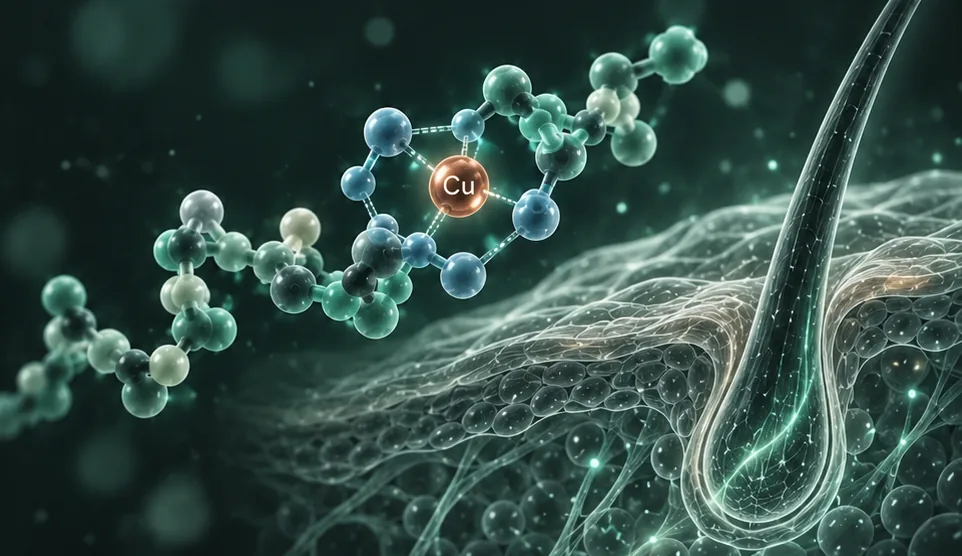
GHK-Cu gives GLOW its cosmetic identity. The copper peptide has been studied in skin biology, collagen production and tissue remodelling In vitro Animal, and it has genuine human research, all of it with products applied to the skin. The strongest result is a 1994 randomised trial of a GHK-Cu gel on diabetic foot ulcers, which reported faster closure than the gel base alone Human 5. A better blinded trial of a copper peptide skincare regimen after laser resurfacing found no objective difference from the regimen without it Human 6.
That creates a translation problem. Topical evidence is not injection evidence. Research on a copper peptide gel or cream placed on skin cannot tell us what happens when GHK-Cu is injected alongside BPC-157 and TB-500. For injectable GHK-Cu, the FDA says there are limited human data to inform safety and that compounded injections may carry a risk of immune reactions from aggregation and impurities 4. BioRx does not treat the topical GHK-Cu literature as evidence that an injectable GLOW stack works. The GHK-Cu guide covers the skin research.
What is KLOW?
KLOW is generally described as GLOW plus KPV, so its four components are GHK-Cu, BPC-157, TB-500 and KPV. The stated idea is that KPV adds an anti inflammatory element to the repair and matrix remodelling components already in GLOW: inflammation control, tissue repair, collagen and cell movement in one vial. It sounds complete. But biology is not built from bricks, and adding another mechanism does not make a treatment more complete. It may simply make it harder to understand.
Klow Stack (GHK-Cu + KPV + BPC-157 + TB-500)
A four compound stack with no combination study in people or animals. KPV has never been tested in a human trial, and its best known results come from mouse colitis models.
Combination evidence. Tier 0: no combination data of any kind; one component has no human data whatsoever
What does KPV add?
KPV is a three amino acid peptide, lysine, proline and valine, that forms the tail end of the hormone alpha-MSH. It has consistent anti inflammatory effects in laboratory and animal work. The best known study showed that KPV enters human intestinal cells through the PepT1 peptide transporter, dampens NF-kB and MAP kinase inflammatory signalling, and, given in drinking water, reduced inflammation in two mouse models of colitis In vitro Animal 7. A second group found benefit in two further mouse colitis models Animal 8.
That makes KPV scientifically interesting, but it has a major limitation. The FDA says it has not identified any human exposure data on drug products containing KPV by any route, and that it lacks important information about whether it would cause harm in people 4. Adding KPV to a blend does not strengthen its clinical evidence. It adds another uncertainty. KPV explained goes through the research.
Why individual evidence does not transfer to a stack
Imagine four ingredients. One has animal tendon data, one has wound healing research, one has topical skin studies, and one reduces inflammation in mouse colitis. Combine them and several things could happen. The effects might complement one another. One might blunt the activity of another. The mix might add side effects without adding benefit. The molecules might reach their peak levels at completely different times. Until the combination is tested, nobody can say which. That is why regulators expect combination medicines to be studied as combinations: evidence cannot be added together like figures on a spreadsheet.
There is one small, direct illustration. A 2026 rat study repaired a cut Achilles tendon and gave BPC-157, TB-500, both together or nothing, with eight rats per group Animal 9. Both single peptides were linked to better tendon structure than no treatment, but the combination gave no additional benefit over either alone. That is two of GLOW's three ingredients, in rats, in one small exploratory study, so it proves nothing about people. It does show that the assumption that two repair peptides must beat one failed the first time anyone checked.
More compounds means more interactions
With one compound, researchers need to understand one molecule. With two, they also need to understand how the pair interact. GLOW has three possible pairings and KLOW has six, before counting what all four do together. That raises questions nobody has answered. Does the copper in GHK-Cu affect the stability of the other peptides? Do all four stay intact in one solution? Do they reach the same tissues at compatible times? Does one pathway interfere with another? Do the safety risks add up? There is no human dataset answering any of these for GLOW or KLOW.
Can one vial prove all four peptides are present?
Analytical testing becomes harder when several peptides share one vial. A single purity percentage does not show the identity of every peptide, the amount of each, sterility, endotoxin levels, or whether breakdown products are present. The FDA's reviews of KPV and TB-500 for the July 2026 advisory meeting judged neither to be well characterised as a bulk ingredient, citing inconsistent naming and a lack of published quality specifications 10 11. A blend makes certificate interpretation more difficult, not easier. How peptides are made explains what a test report can and cannot show.
Does the name "stack" mean synergy?
No. "Stack" is community slang for substances taken together. Synergy has a specific scientific meaning: the combined effect is greater than would be expected from the separate effects. Showing it needs an experiment that compares the combination with each component and with a control. A product description cannot do that, and for GLOW and KLOW nobody has run the experiment.
Are GLOW and KLOW approved medicines?
No. Neither blend is an approved medicine anywhere, and none of the four ingredients is approved for any therapeutic use in the UK or the US. In the UK none has an MHRA marketing authorisation as a medicine, and supplying them for human use would fall under the Human Medicines Regulations 2012; GHK-Cu is allowed only as a cosmetic ingredient on the skin.
In the US, BPC-157, KPV and TB-500 were all discussed by the FDA's Pharmacy Compounding Advisory Committee on 23 July 2026, which considered whether compounding pharmacies may use them 12. FDA staff recommended against all three, finding no human data on KPV or TB-500 by any route. The committee voted in favour of adding them to the compounding list, but its vote is advisory and not an agency decision 13. Even if the FDA agreed, that would permit compounding, which is not drug approval and not a finding that anything works. GHK-Cu was not on that agenda, and no blend was.
For athletes, BPC-157 is prohibited at all times under section S0 of the WADA Prohibited List and TB-500 under section S2 14, so both GLOW and KLOW contain two banned substances.
GHK-Cu
Mixed evidenceTissue repair · 10 cited studies
A multicentre randomised evaluator blinded trial in diabetic ulcers reported a large healing benefit, but the best controlled dermatological trial found no between group difference on objective endpoints, and the widely cited facial cream studies are unindexed conference abstracts.
UK status. Permitted as a cosmetic ingredient under the UK Cosmetics Regulation for topical use with cosmetic claims only.
BPC-157
Preclinical onlyTissue repair · 9 cited studies
The 2025 HSS Journal systematic review screened 544 articles and included 36, of which 35 were preclinical and the single clinical item was a retrospective series of 12 patients; the widely repeated claim that BPC-157 was 'safe in clinical trials' for inflammatory bowel disease traces to assertions inside review articles, not to any published trial report.
UK status. No MHRA marketing authorisation.
TB-500 (thymosin beta-4)
Mixed evidenceTissue repair · 10 cited studies
Genuine randomised, placebo controlled Phase 2 and Phase 3 trials exist in venous ulcers, pressure ulcers, dry eye and myocardial infarction, involving well over a thousand registered participants in total, but the large ophthalmic programme has not delivered a published primary endpoint success and no regulator has approved the peptide for any indication.
UK status. No MHRA marketing authorisation for any thymosin beta-4 product.
KPV
Preclinical onlyTissue repair · 5 cited studies
Well replicated cell and rodent data across multiple independent laboratories, but a ClinicalTrials.gov query returns no registered trial with KPV as an intervention, and PubMed contains no human efficacy or safety study of any kind.
UK status. No MHRA authorisation.
Could GLOW or KLOW still turn out to be useful?
Of course. That is what research is for. There is a reasonable scientific argument for studying combinations that act on different parts of wound and tissue biology. But the correct conclusion from that argument is that the combination deserves testing, not that it has been shown to work. Those two statements are separated by the whole clinical research process: a defined product, a stable formulation, safety studies, and trials that compare the blend with its parts.
The BioRx conclusion
GLOW usually combines BPC-157, TB-500 and GHK-Cu, and KLOW adds KPV. Each component has its own research story, mostly in animals and cells, with human data that is thin for BPC-157, confined to skin products for GHK-Cu, and absent for the TB-500 fragment and KPV. Neither named stack has any controlled evidence, in people or in animals, that the combination produces the claimed effects. That makes them research ideas, not established therapies. The biggest mistake with peptide stacks is assuming that combining four mechanisms also combines four evidence bases. It does not. A stack needs evidence for the stack, and for GLOW and KLOW that evidence is missing.
Frequently asked questions
What is in the GLOW peptide stack?
GLOW usually contains BPC-157, TB-500 and GHK-Cu. There is no standard formula, so amounts and forms vary between products sold under the name.
What is the difference between GLOW and KLOW?
KLOW is GLOW with KPV added, a three amino acid fragment of the hormone alpha-MSH studied for its effects on inflammation in cells and mice.
Has the GLOW or KLOW stack been tested in clinical trials?
No. No trial of either blend has been published or registered on ClinicalTrials.gov, and no animal study has tested either full combination.
Is the GLOW or KLOW stack legal in the UK?
None of the ingredients has an MHRA authorisation as a medicine, and supplying them for human use falls under the Human Medicines Regulations 2012. GHK-Cu is permitted only as a cosmetic ingredient for use on the skin.
Are GLOW and KLOW banned in sport?
Both contain BPC-157 and TB-500, which are on the WADA Prohibited List at all times.
References
Studies marked "View study in BioRx" sit in the clinical studies index with their design and evidence grade.
- Vasireddi N et al. (2025). Emerging Use of BPC-157 in Orthopaedic Sports Medicine: A Systematic Review. HSS Journal.PubMed · DOI · View study in BioRx
- Mateescu DM et al. (2026). BPC-157 as an Investigational Peptide Therapeutic: Biopharmaceutical Challenges, Formulation Strategies, and Translational Development Barriers. Pharmaceutics.PubMed · DOI · View study in BioRx
- Esposito S et al. (2012). Synthesis and characterization of the N-terminal acetylated 17-23 fragment of thymosin beta 4 identified in TB-500, a product suspected to possess doping potential. Drug Testing and Analysis.PubMed · DOI · View study in BioRx
- FDA, Certain bulk drug substances for use in compounding that may present significant safety risks
- Mulder GD, Patt LM, Sanders L, Rosenstock J, Altman MI, Hanley ME, Duncan GW (1994). Enhanced healing of ulcers in patients with diabetes by topical treatment with glycyl-l-histidyl-l-lysine copper. Wound Repair and Regeneration.PubMed · DOI · View study in BioRx
- Miller TR et al. (2006). Effects of topical copper tripeptide complex on CO2 laser-resurfaced skin. Archives of Facial Plastic Surgery.PubMed · DOI · View study in BioRx
- Dalmasso G et al. (2008). PepT1-mediated tripeptide KPV uptake reduces intestinal inflammation. Gastroenterology.PubMed · DOI · View study in BioRx
- Kannengiesser K et al. (2008). Melanocortin-derived tripeptide KPV has anti-inflammatory potential in murine models of inflammatory bowel disease. Inflammatory Bowel Diseases.PubMed · DOI · View study in BioRx
- Biçer O et al. Effects of BPC-157 and TB-500 on Achilles tendon healing in rats: a histopathological and biomechanical study. Joint Dis Relat Surg 2026
- FDA briefing document, KPV related bulk drug substances, Pharmacy Compounding Advisory Committee, July 2026
- FDA briefing document, TB-500 related bulk drug substances, Pharmacy Compounding Advisory Committee, July 2026
- FDA, Pharmacy Compounding Advisory Committee meeting, 23 and 24 July 2026
- Mintz, FDA's advisory committee votes on peptides: what it does and doesn't do, July 2026
- WADA, Prohibited List